
5 min read
997 words
In the constant search for the perfect family game night, we often face a familiar challenge: finding a game that is quick to learn, fast to play, and engaging for both kids and adults. It’s a tall order. So, when we got our hands on Flip Over Frogs from Hub Games, a charming little box promising a 10-minute adventure, we were cautiously optimistic. Could this be the new go-to game for a quick dose of family fun?
Designed by the clever minds at Okabe Games in Japan, Flip Over Frogs immediately stands out with its simple premise and vibrant, friendly art style. It’s an abstract strategy game that swaps complex rules for clever mechanics, centered around, you guessed it, a pond full of colorful frogs. After several rounds of flipping, plotting, and a few surprise victories, we’re ready to share our thoughts on this delightful tile-laying game.
What’s Hoppening in the Box? A Quick Gameplay Overview
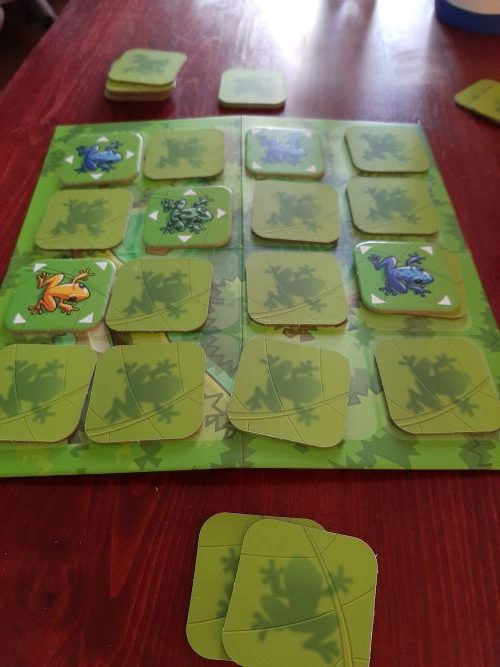
Flip Over Frogs is a game of secret identities and area control on a compact 4×4 grid. The goal isn’t just to have the most frogs on the board, but to have the most frogs of your secret color showing when the game ends.
Here’s a leap-by-leap look at how it works:
1. The Secret Identity
At the start of the game, each player receives a secret Frog Token. This token shows which of the four frog colors is theirs. This is your secret! Keep it hidden from your opponents, as knowing who is collecting which color is a huge strategic advantage.
2. Placing Your Tiles
Each player starts with a hand of three frog tiles. On your turn, you simply choose one tile from your hand and place it on the board. You have two options for placement:
- On any empty space.
- On top of any face-down tile, creating a stack.
Critically, you can never place a frog on top of a tile that is already face-up. This keeps the board state constantly evolving.
3. The Big Flip!
This is the core mechanic and where the magic happens. Every frog tile has arrows pointing to one or more of the adjacent (including diagonal) spaces. When you place your tile, you must flip over any tiles in the spaces indicated by the arrows on the tile you just played.
If a space has a stack of tiles, the entire stack flips over together! This can lead to dramatic shifts in power as a face-up frog becomes hidden and the face-down frog beneath it is suddenly revealed. Only the tile you just placed triggers flips—there are no chain reactions.
4. The Sneaky Snake
Mixed into the deck are four Snake Tiles. These slippery characters add a bit of “take that” to the game. When you play a Snake Tile, you can choose any single face-up frog on the board and remove it from the game entirely. It’s a powerful move to thwart an opponent who is getting a little too far ahead.
5. How to Win
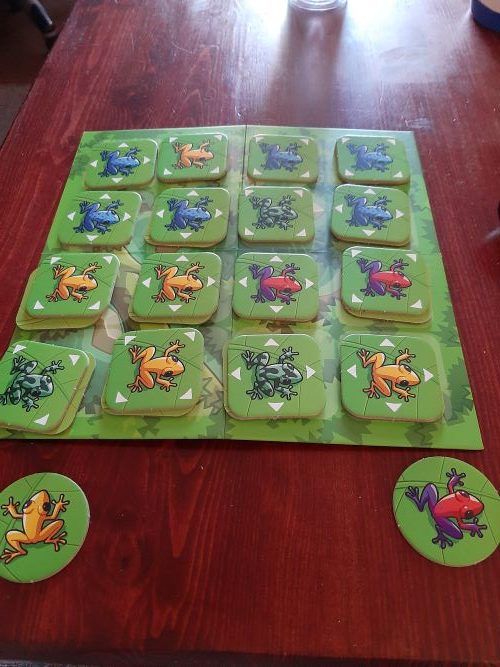
The game ends one of two ways: either the board is filled with sixteen face-up frogs, or no player can make a legal move.
Once the game is over, everyone reveals their secret Frog Token. You then count up all the face-up frogs of your color on the board. The player with the most frogs of their color is crowned the winner!
Our Family Game Night Experience
From the very first turn, Flip Over Frogs created a fantastic dynamic at our table. The secret identity element is brilliant. It turns a simple placement game into a fascinating puzzle of deduction. You find yourself asking, “Why did they place that frog there? Are they trying to flip my red frog, or are they trying to reveal the blue one underneath? Wait, are they blue?”
The flipping mechanic, while simple in concept, took our youngest player a game or two to fully grasp. The idea that a single placement could cause multiple tiles to flip, and that stacks moved as a single unit, required a bit of a mental adjustment. However, once it clicked, it really clicked. That “aha!” moment was followed by gleeful, strategic plays designed to bury our frogs and reveal their own.
We loved the pacing. At around 10 minutes per game, it never outstays its welcome. It’s the perfect game to play while dinner is in the oven or as a quick tie-breaker between longer games. The snakes add just enough tension without feeling mean-spirited, creating moments of mock betrayal and laughter.
The only minor negative we could find aligns with our initial learning experience: the spatial logic of the flips might be a small hurdle for children under 7 or 8. It’s not a major issue, but parents should be prepared to play the first game with an “open hand,” guiding them through the consequences of their tile placements.
Final Verdict: Who Should Buy Flip Over Frogs?
Flip Over Frogs is a resounding success in our book. It’s a game that hits that sweet spot of being easy to teach, fast to play, but with a surprising amount of strategic depth. The combination of memory (what’s under that stack?), deduction (who is who?), and lighthearted sabotage makes every game feel fresh and exciting.
We highly recommend Flip Over Frogs for:
- Families with Elementary School-Aged Kids: It’s a fantastic way to introduce concepts of strategy and spatial reasoning in a fun, accessible package.
- Couples and Casual Gamers: It makes for a perfect two-player duel or a light opener for a game night with friends.
- Fans of Abstract Strategy Games: If you enjoy classics like Othello/Reversi but want something with a modern twist and a touch of hidden information, this is for you.
This little box packs a huge amount of fun and has earned a permanent spot on our game shelf.
Game Details
- Game: Flip Over Frogs
- Publisher: Hub Games
- Designer: Okabe Games
- Players: 2-4
- Playtime: 10-15 Minutes
- Age: 6+
 Christy Jernigan
  April Franke