
Why Getta 1 Games Are a Essential Investment
8 min read
1401 words
In the fast-paced world of early childhood education, parents are constantly searching for tools that don’t just occupy their children, but genuinely engage and educate them. Ditching the dull flashcards and screen time reliance is key; the modern preschooler thrives on interaction, touch, and play. If you are looking for a fun, tactile, and highly effective way to help your preschooler master crucial foundational skills, look no further than the remarkable collection of learning tools from Getta 1 Games.
These games are not mere distractions; they are expertly designed instruments of cognitive development, promoting early literacy, math aptitude, and essential physical skills that set the stage for academic success. We believe that investing in high-quality, fun learning games is one of the most proactive steps you can take to ensure your child thrives in their educational journey.
Here, we dive deep into two standout offerings from Getta 1 Games—a powerful combination that addresses both foundational academics and developmental physical coordination.
The Power of Playful Learning: Why Educational Games Triumph
Before exploring the individual games, it is crucial to understand the philosophy behind them. Young children learn best through experiential play. When a child manipulates a wooden object, rolls a die, or successfully completes a challenging task, they are not passively absorbing information; they are actively building neural pathways.
Getta 1 Games excels because it bridges the gap between structured learning and pure, uninhibited fun. Their products utilize durable materials (like high-quality wood) that appeal to a child’s senses, offering a satisfying tactile experience that reinforces concentration and material retention.
By incorporating these interactive tools into your daily routine, you are not just passing the time; you are fostering:
- Increased Concentration: Games require focus, gradually extending a child’s attention span—a critical skill for classroom readiness.
- Problem-Solving Skills: Every turn, every rule, every challenge requires critical thinking and decision-making.
- Positive Association with Learning: When learning feels like a reward and a source of joy, children develop a lifelong love of education.
Now, let’s look at two specific games that exemplify this powerful approach.
Teach the Time Clock Game: Mastering the Abstract in a Tangible Way
(Subheading 2)
Telling time is perhaps one of the most abstract and difficult concepts for a young child to grasp. It requires simultaneous understanding of numbering systems, counting by fives, and recognizing the movement of two different hands. Often, traditional methods fall short, leaving both parents and children frustrated.
This is where the Teach the Time Clock Game from Getta 1 Games proves itself to be an indispensable tool.
A Multi-Tiered System That Grows With Your Child
Teach the Time Clock is far more than a simple toy clock; it is a comprehensive learning system disguised as a beautiful wooden puzzle and game. Its genius lies in its ability to cater to multiple developmental stages simultaneously, ensuring longevity and maximum return on your investment.
For the Budding Learner (Ages 3-4): The initial levels focus purely on foundational skills. The game includes 12 double-sided wooden pieces (representing the hours and minutes). At this stage, children are using the clock face like a puzzle, learning:
- Number Recognition: Identifying the numerals 1 through 12.
- Color and Shape Recognition: Matching the colorful wooden pieces back into their corresponding spots on the clock face.
- Counting: Physically counting the clock segments.
For instance, if your child is currently working on basic number recognition in junior kindergarten, this game provides a hands-on, highly engaging complement to their classroom studies. It transforms abstract numbers on a page into physical objects they can place and manipulate.
For the Advanced Learner (Ages 5+): As your child progresses, the game transitions seamlessly into its intended purpose: teaching time. The movable plastic hands, custom time dice, and the ability to switch the double-sided pieces to focus on hour or minute intervals provide structured steps toward mastery.
The included components guide the learning process:
- Durable Wooden Clock Puzzle: Offers a satisfying, tactile learning experience superior to plastic alternatives.
- Movable Hands: Allow the child to physically set the time, reinforcing the relationship between hand position and number.
- Two Custom Time Dice: These dice introduce randomization and game-based challenges, making practice feel like an exciting competition rather than a chore.
The Persuasive Impact:
Overall, Teach the Time Clock is a demonstrably more fun and effective way to help children learn how to tell time. By starting with simple matching and counting and building toward complex time sequencing, it removes the intimidation factor. It ensures that when your child encounters time concepts in school, they already possess a strong, tangible mental model of how a clock works, setting them up for immediate success.
Piggy Pile-Up: Building Essential Fine Motor and Focus Skills
(Subheading 3)
While academic mastery is paramount, early education success is also heavily dependent on the development of physical dexterity, specifically fine motor control and hand-eye coordination. These skills are the essential prerequisites for handwriting, drawing, and general self-care.
Enter Piggy Pile-Up from Getta 1 Games—a simple, brilliant game of balance that immediately becomes a family favorite.
A Fast-Paced Test of Patience and Motor Control
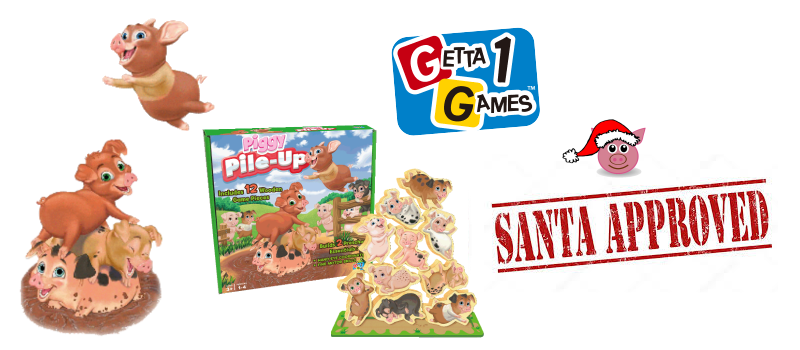
Piggy Pile-Up is a dexterity game where players carefully add small, wooden piggy pieces to a precarious base (the cardboard ‘mud puddle’). The objective is straightforward: be the first player to place all your piggies without causing the tower to tumble.
While the premise is delightfully whimsical, the educational benefits are incredibly serious and far-reaching:
1. Hand-Eye Coordination and Precision
Adding a wooden pig (even a small one) requires precise movements. This game demands that the child coordinate what they see with how they move their hand, engaging the small muscles necessary for later academic tasks. The need to slow down, aim, and gently place the piggy piece directly reinforces the control required for holding a pencil correctly or using scissors effectively.
2. Concentration and Problem-Solving
This game requires intense focus. Children must analyze the existing structure, anticipate where the weight will shift, and solve the problem of stability with each turn. If a piece falls, the child must retrieve it and try again, teaching resilience and patience. This practice in self-regulation and intense concentration is invaluable preparation for a structured learning environment.
3. Counting and Turn-Taking
Piggy Pile-Up is best played with 2 or 3 players. It naturally encourages turn-taking and adherence to rules. Furthermore, the act of distributing an equal number of pieces to each player, counting the pieces that fall, and keeping track of who goes next subtly reinforces foundational math and social skills.
The Parent’s Secret Weapon: Independent Play
As any parent of a preschooler knows, games that a child can play effectively on their own, as well as with a parent, are a true treasure. Piggy Pile-Up excels in this area. While competitive play is fun, the nature of the challenge means a child can easily practice the stacking and balancing independently, allowing busy parents a few precious minutes of freedom while knowing their child is still engaged in productive, skill-building activity.
The game’s fast pace also makes it the perfect “pull-out” activity—a quick, satisfying challenge right before dinner or during a transition time. Given its frequent use and ability to engage children daily, this game transforms into one of the most cost-effective educational purchases you can make.
Investing in Quality, Durability, and Fun
The commitment of Getta 1 Games to quality is evident in the materials used. Focusing on durable wooden components ensures that these games withstand the inevitable rough handling of the preschool years. These are not flimsy, disposable toys; they are teaching tools designed to last through multiple children and developmental stages.
Whether you prioritize exceptional educational content, tactile wooden components, or cool and quirky learning mechanisms, Getta 1 Games delivers. Their curated selection guarantees that you can find the right game to address specific developmental needs—from academic mastery to physical coordination.
Conclusion: Setting the Stage for Lifelong Success
Educational games are not a luxury; they are a necessary component of holistic preschool development. The Teach the Time Clock Game and Piggy Pile-Up exemplify how Getta 1 Games transforms complex skills—temporal understanding, focus, and fine motor dexterity—into joyful, accessible experiences.
By incorporating these Preschool Learning Games into your child’s routine, you are providing a valuable educational tool that ensures they are not only prepared for school but are enthusiastic about learning. Give your child the edge they deserve by choosing interactive, high-quality, and fun learning tools today. Invest in Getta 1 Games, and watch your child thrive.


The piggy game sounds really fun, and a great one to play with the grandchildren!
Any game which helps teach time is useful and Piggy Pile Up is great for placement thinking and motor skills.
I think these games sound wonderful. They help with counting and concentration.
My children would love this. So many benefits to these toys. Problem solving, counting, balance is exactly what I look for in a toy.
I think both games are great, love that they both encourage learning while having fun.
I think my daughter will love these and will help with concentration
I like both of them. I think they will encourage learning while playing
anything that keeps the littles learning and doing it in a fun way is great
Getting familiar with a clock is a must! We have a similar clock game, and it’s definitely helped my kiddo learn about time! Piggy pile looks like a fun and silly game that would help with problem solving!
I’ve been looking for games for my nephew to play! and EVERYone needs to know how to tell time. and maybe, just maybe he’d want to play that game without him wanting someone to do it for him
I like that the Teach the Time game would help a variety of ages learn that skill. I can see my son and daughter both enjoying this and learning something from it. The Piggy Pile Up would be excellent for developing motor skills. Both look fun! Thanks.
I think these are great, especially to help with learning to count.
I really like the clock game, as learning to tell time is difficult for kids. I love that it incorporates colours and is wooden. And I really like the Piggy Pile Up. I can also see my daughter playing with it independently, which is so great for kids.
I think that the piggy game would help JJ with his coordination while still having fun. I think the other game would help with colors and numbers.
These sound wonderful. I know my little one loves to count!
I think the clock is defin beneficial for obvious reasons, the Piggy game, would really help them with thinking and creating a plan, being strategic… hand and eye coordination! Super games thank you so much
I love both of these games and know that my grandkids would also love them!
I love games that actually make learning fun. It seems like anything when you are having fun, they soak it all in without even trying.
Hand and eye coordination and counting are both skills that these games would help with!
Hand and eye coordination are really important for young minds and learning to tell time threw fun is a great concept.
These games seem to make learning fun which is the most important feature to me 🙂
I think they are both great – one for cognitive and the other for fine motor
Teach the time clock game is a great learning tool. I literally work with a fellow who can only read digital time
These would both develop fine motor skills in kidlets, they could learn numbers, time and balance as well.
Very good games for fine motor skills and number recognition.
I love the piggy pile up game! It looks like a great game to teach coordination.
Oh my gosh how precious is that! I gotta get this game to play with my kids 🙂