
8 min read
1444 words
As parents, there are few things more rewarding than witnessing that spark – the moment your child discovers a new passion and dives headfirst into it. For me, that joy has recently come in the form of melody and rhythm, as my daughter has developed a profound interest in music. Her curiosity is boundless, and my mission, as any devoted parent would agree, is to nurture that budding interest in every way possible. In my quest for engaging, foundational music tools, I stumbled upon a true gem: Compose Yourself by ThinkFun. This isn’t just another game; it’s a brilliant, intuitive portal into the world of creative musical expression. It has proven to be an absolutely fantastic tool for helping my daughter not just understand, but truly feel and appreciate music on a profoundly deeper level. Beyond the notes and rhythms, it’s sparked a genuine, uninhibited love for creative expression that resonates throughout our home, turning ordinary afternoons into impromptu composition sessions.
Unleashing Musical Creativity: Beyond Traditional Notes
Imagine a world where creating music isn’t about deciphering complex notation on a page, but about arranging vibrant colors and shapes. That’s precisely the innovative genius behind Compose Yourself. This game brilliantly sidesteps the initial intimidation of traditional sheet music, offering a welcoming, playful entry point into musical composition.
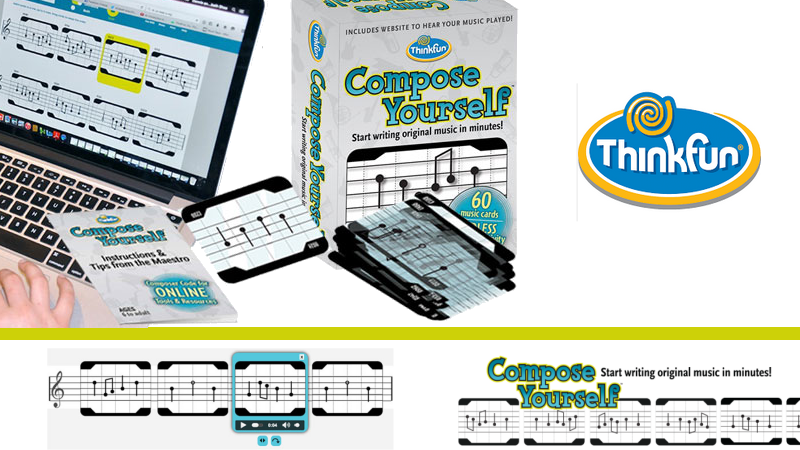
Instead of staves and clefs, Compose Yourself utilizes a collection of ingeniously designed, color-coded cards. Each card represents a unique musical phrase – a short, distinct segment of melody or rhythm. The true magic lies in the tactile experience: kids can physically manipulate these cards, arranging them in countless different sequences. This hands-on approach transforms the abstract concept of music into something tangible and immediate. My daughter doesn’t just think about music; she builds it. She experiments by lining up a cheerful yellow phrase with a contemplative blue one, then perhaps a repetitive green pattern. Each arrangement is a new, unique composition waiting to be heard. It’s a system designed not just to teach, but to empower, giving young minds the immediate gratification of creating something entirely their own, from the ground up, without a single overwhelming “C Major” scale in sight.
The Magic of Simplicity: Intuitive Learning for Little Maestros
The beauty of Compose Yourself is undeniably rooted in its elegant simplicity. From the moment we opened the box, my daughter – who is still quite young and just beginning her formal learning journey – was able to grasp the core concept almost immediately. There was no laborious tutorial, no lengthy rulebook to memorize. The intuitive nature of the game allowed her to jump right in, her small hands eagerly shuffling and arranging the colorful cards.
This immediate accessibility is a pivotal factor in fostering engagement. Children, especially young ones, thrive on independence and the feeling of accomplishment. Compose Yourself provides precisely that. She wasn’t just following instructions; she was leading her own musical exploration. Each card she placed, each sequence she created, was a choice, an experiment, a step towards a burgeoning sense of mastery. This inherent ease of use eradicated any potential frustration, replacing it instead with pure, unadulterated curiosity and a delightful sense of “I can do this!” It’s a powerful reminder that sometimes, the most profound learning experiences are born from the least complicated designs. And in our cozy home environment, where creativity is encouraged, even our furry family member seems to appreciate the peaceful engagement. While my daughter delves into her musical creations, our beloved dog often settles into the plush comfort of his favorite dog bed nearby, a testament to the calm, focused atmosphere this game helps to cultivate.
Beyond Play: Discovering the Secrets of Musical Structure
What truly elevates Compose Yourself beyond a mere game is its subtle yet profound ability to impart fundamental musical concepts. While my daughter is having a blast arranging her color-coded phrases, she is unconsciously absorbing core principles that form the very bedrock of music theory. She’s learning by doing, not by rote memorization.
Through repeated play, she has begun to understand how different musical phrases interact and sound when placed next to each other. She experiments with putting a “loud” phrase next to a “soft” one and hears the immediate impact. She discovers the power of repetition, how a recurring motif can create a sense of familiarity or build tension. The concept of varying tempo and dynamics – how fast or slow, loud or soft a piece can be – becomes naturally evident as she manipulates the cards and hears the resulting composition played back via the accompanying app.
This experiential approach to learning is infinitely more engaging and effective than simply memorizing notes or definitions from a textbook. It’s ignited a genuine, eager curiosity about why music sounds the way it does. She’ll ask questions like, “Mommy, why does this sound happy when I put these together?” or “How can I make it sound like a storm?” These are the nascent sparks of a true understanding of music theory, blooming organically from playful exploration. It’s not just about what a note is, but what it does and what it feels like – a critical distinction for fostering deep appreciation.
More Than Just a Game: A Catalyst for Connection and Growth
Compose Yourself has transcended its physical form in our household; it’s become far more than just a box of cards and an app. It’s a vibrant tool for family bonding, a dynamic platform for uninhibited creative expression, and a powerful stepping stone towards a lifelong appreciation for the intricate beauty of music.
Some evenings, we’ll gather around the table, taking turns adding cards to a shared composition, each of us contributing a unique “voice” to the emerging melody. These moments are invaluable – fostering teamwork, active listening, and shared enjoyment. It’s a beautiful way to connect, to see the world through her eyes as she explains the “story” her music is telling. Beyond the direct interaction, the game also serves as a fantastic outlet for solitary creative expression. She can retreat into her own world of sound, designing intricate pieces that reflect her mood or her imagination, developing an inner landscape of artistry. This type of self-directed play is crucial for cognitive development, problem-solving skills, and emotional intelligence. Compose Yourself doesn’t just teach music; it nurtures the whole child, building a foundation for imaginative thought and an enduring connection to the arts.
Building Confidence, One Melody at a Time
Perhaps one of the most heartwarming outcomes has been the incredible boost in my daughter’s confidence. Seeing her create her very own songs, even simple ones at first, has been an incredibly empowering experience for her. The sheer joy and pride that radiate from her face when she hears her unique composition played back through the accompanying app is, quite simply, priceless. The carefully designed app takes her card arrangement and translates it into an audible, polished piece of music, bringing her abstract ideas to life in a tangible, rewarding way.
This immediate feedback loop reinforces her efforts and validates her creativity. It’s a powerful affirmation that her ideas have merit, that her imagination can manifest into something beautiful and real. This sense of accomplishment doesn’t just stop at music; it spills over into other areas of her life, encouraging her to take risks, to explore new challenges, and to believe in her own potential. It’s incredible to witness how a simple game can have such a profound impact on a child’s self-esteem and willingness to keep exploring her musical potential, pushing her own boundaries with each new melody she crafts.
Fostering a Lifelong Love for Music
Ultimately, Compose Yourself by ThinkFun has done something truly extraordinary: it has helped my daughter connect with music in a more personal, profound, and meaningful way than I ever imagined possible. It’s transformed her relationship with sound from passive listening to active understanding and creation. Music is no longer just background noise or someone else’s art; it’s a language she is learning to speak, a medium through which she can express her own inner world.
It’s not just about listening to songs anymore; it’s about understanding the fundamental building blocks of music, appreciating the intricate patterns and emotional nuances, and, most gloriously, having the freedom and the tools to create her own masterpieces. And that, to me, is the most beautiful melody of all. If you are a parent searching for a fun, engaging, and genuinely effective way to introduce your child to the enchanting world of music – or to deepen an existing interest – I wholeheartedly recommend giving Compose Yourself a try. You might just be surprised at the musical genius waiting to be unlocked in your own home!
 Christy Jernigan
  April Franke
  Rose DesRochers