TikTok Dangers: What Your Videos Reveal About You
12 min read
2229 words
Canada has proposed legislation that would restrict children under 16 from having accounts on certain regulated social media services. Bill C-34, the proposed Safe Social Media Act, was introduced by the federal government on June 10, 2026. The proposed legislation would establish a minimum age of 16 for accounts on certain regulated social media services, with a possible exemption for a service that can demonstrate sufficient safeguards for children. The legislation is still moving through Parliament and has not become law. As of September 2026, Bill C-34 is at second reading in the House of Commons.
Whatever happens with the legislation, it raises an important question for parents: What are children and teenagers actually sharing when they post videos online?
A TikTok video can seem harmless. A teenager might post a dance, a funny moment with friends, a video with the family dog or a clip filmed outside school.
But the person making the video may not realize how much information they are revealing.
A home address does not have to appear on the screen. A school name does not have to be spoken. Sometimes a location, relationship or routine can be identified from what is visible or what is said.
And the more videos someone posts, the more information may become available.
Public Accounts Increase Exposure
This is particularly important when an account is public.
A public account can make videos available to people the person posting them does not know. A viewer does not have to be a friend, classmate or neighbour to see what has been shared.
A stranger may also be able to look at several videos from the same account and connect details that were never intended to be connected.
One video might show a school.
Another might show a local restaurant.
Another might include a friend’s name.
A later video might show the neighbourhood or the inside of the home.
The individual videos may seem harmless. Together, they can reveal considerably more.
That is the privacy issue I want to look at in this article.
Why Is Canada Looking at Social Media and Children?
The proposed federal legislation is broader than TikTok.
Bill C-34 would establish new responsibilities for certain social media and AI chatbot services, including requirements related to children’s safety, harmful content, platform design and transparency. The proposed framework would also establish a Digital Safety Commission of Canada to oversee the legislation.
The proposed minimum age of 16 is one part of the legislation.
Whether the bill becomes law, and what the final rules would look like, remains to be determined as the legislation moves through Parliament.
Parents do not have to wait for legislation to start talking with their children about privacy.
I have had conversations with my own daughter about what can be shared online and how easily personal information can be revealed, even though she does not use TikTok.
Your Location Can Be Revealed Without Posting Your Address

You do not need to post an address for someone to work out where a video was filmed.
A teenager might record a TikTok outside school without realizing what is visible in the background.
A school sign, logo, team uniform, bus, entrance or nearby street can identify the school.
Other clues might include a playground, sports facility, shopping centre, bus stop, local landmark or distinctive building.
Even the outside of a home can provide useful information, particularly when several videos from the same account show the same neighbourhood.
A single clue may not seem important. However, someone familiar with the area may recognize it immediately, while someone unfamiliar with the area could potentially connect several clues from different videos.
Before posting, look beyond the person in the video.
Ask yourself:
Could someone figure out where this was filmed?
Be Careful About Posting Other Children

Posting about friends can reveal information about them too.
Saying “Sarah is my best friend” or “I’m going over to Emma’s house later” can identify another child, connect them to an account or reveal where they spend time.
A video may also show their face, home, school or usual activities.
For that reason, children should think carefully before identifying friends by full name, username, school or other personal details on public accounts.
If another child appears in a photograph or video, it is also worth considering whether their parent or guardian is comfortable with the image being shared, particularly when the account is public.
A child may be happy to appear in a funny video, but that does not necessarily mean their parent is comfortable with their child’s image or personal information being available to strangers.
I have seen this boundary in my own life. One of my daughter’s friends does not allow photographs of her daughter to be taken by other people. I respect that decision because it is a good reminder that we should never assume another parent is comfortable with their child’s photograph being shared.
I also have my own boundaries around photographs of my daughter. I am cautious about allowing photographs of her to be sent between children because once a photograph leaves someone’s phone, there is no longer complete control over what happens to it.
It can be saved, forwarded, copied or shared with someone else.
The same concern applies to videos filmed around the neighbourhood.
Recognizable houses, playgrounds, street signs and landmarks can reveal where a child lives or spends time. Someone who knows the area may recognize it immediately, while a stranger may be able to work it out by putting several clues together.
When other children are involved, it is better to respect their privacy than assume they are comfortable being identified online.
If there is any doubt, ask the parent or guardian before taking or sharing the photograph or video.
Videos Inside the House Can Reveal a Lot
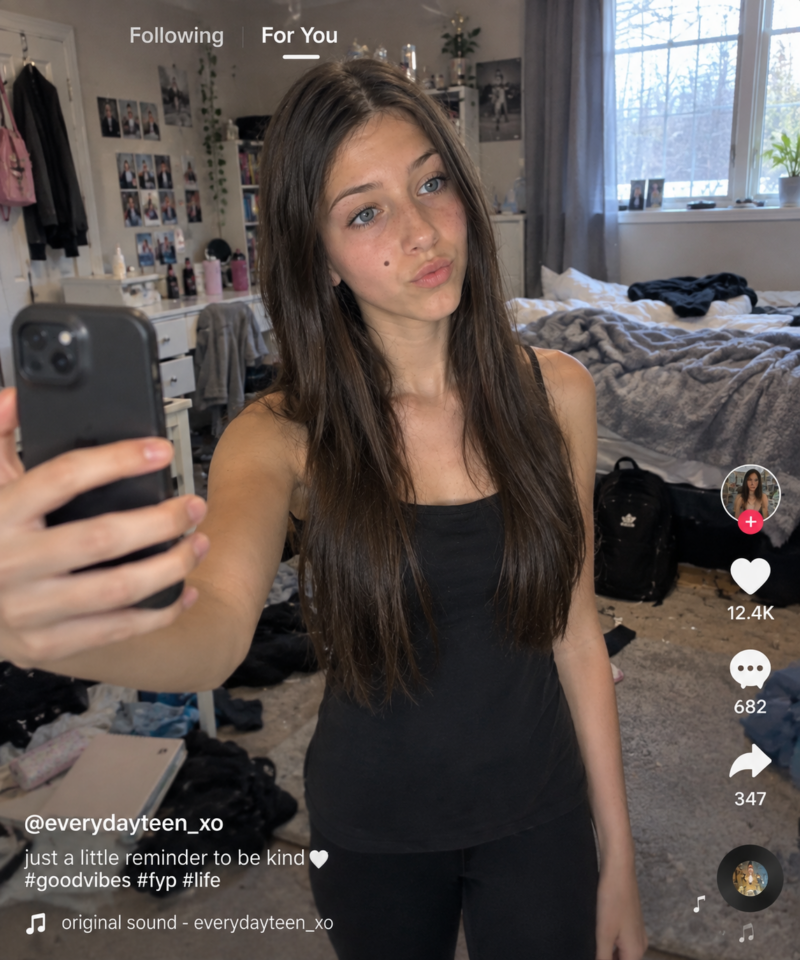
Filming inside the home can reveal personal information without the person recording realizing it.
The background might show:
- Family photographs
- Children’s names
- School papers
- Certificates
- House numbers
- A parent’s name
- Family members
- Personal belongings
- The view outside a window
- Details about the home
The person making the video may be concentrating on what they are saying or doing while viewers are looking at everything else in the frame.
Before posting, take a few seconds to check the background.
What personal information is visible that you did not intend to share?
TikTok Collects More Than What You Post
There is another side to the privacy question.
TikTok does not only receive the information people deliberately put into a video.
A joint investigation by Canada’s federal Privacy Commissioner and privacy regulators in Quebec, British Columbia and Alberta examined TikTok’s collection, use and disclosure of personal information, with particular attention to children and young users.
The investigation, published in September 2025, found that TikTok collected a broad range of information. The investigation identified user-provided information, device information, behavioural information, contact information and location-related information among the data collected or derived through use of the service. It also examined TikTok’s use of information for content personalization and targeted advertising.
The investigation also found deficiencies in TikTok’s age-assurance measures. The privacy authorities concluded that the measures used to keep children under the platform’s minimum age from accessing TikTok were inadequate. TikTok subsequently committed to strengthening its age-assurance methods and improving privacy communications.
For parents, this is an important distinction.
There is the information a child deliberately shares in a video.
Then there is the information a platform may collect or derive from someone’s use of the service.
Both are part of the larger privacy picture.
Posting Over Time Can Reveal a Routine
One video may reveal very little.
Several videos can reveal much more.
For example, a teenager might regularly post videos from school, a local coffee shop, a corner store, a neighbourhood park or a shopping centre.
None of those posts necessarily reveals where the teenager lives.
But taken together, they can show where the person goes regularly and potentially provide clues about their routine.
This is why it is worth thinking about the information contained in a series of posts rather than looking at each video separately.
Be Careful About Posting in Real Time
Timing can add another layer of information.
Compare:
“We had a great day at the movies!”
with:
“We’re going to the movies tonight. We’ll be there at 7.”
The first tells people about something that has already happened.
The second tells people where someone plans to be and when.
The same idea applies to vacations.
Some families may prefer to share photographs after returning rather than announcing that they are away.
Waiting to post can reduce the amount of information being shared about someone’s current location.
Don’t Assume a Private Account Makes Everything Private
A private account can give users more control over who sees their content, but it does not guarantee that everything remains private.
Someone with access to a video could:
- Take a screenshot
- Screen record it
- Share it with someone else
- Show it to another person
Once something has been shared, the person who originally posted it has less control over what happens to it afterwards.
That does not mean children should assume every person they know will misuse their photographs.
It simply means they should understand that sharing something digitally is different from showing it to someone standing beside them.
Five Questions to Ask Before Posting
One of the easiest ways to teach children about online privacy is to have them pause before posting and look at the video from someone else’s perspective.
Ask:
1. Where am I?
Could someone identify the location?
2. Who is in the video?
Have I included friends, neighbours or other people who may not want to appear online?
3. What am I saying?
Have I mentioned my school, plans, routine or other personal details?
4. What can someone see?
Check the background for signs, uniforms, documents, photographs, house numbers and other identifying details.
5. Would I be comfortable if someone I don’t know saw this?
If the answer is no, consider changing the video or not posting it.
The goal is not to make children afraid of technology.
It is to help them recognize information they may not realize they are sharing.
My Personal View on TikTok and Younger Children
After looking at the privacy issues surrounding social media videos, I have concerns about TikTok for younger children.
Personally, I would prefer to wait until a child is at least 16 before allowing them to have a TikTok account.
That is my own parenting preference, rather than a statement about what every family should do.
TikTok can be entertaining and creative, and families will have different views about when their children are ready for social media.
My concern is how easily information can accumulate over time.
A child may not think twice about showing a school, mentioning a friend, filming inside the house or posting about where they are going.
A single post may seem harmless, but information shared repeatedly can provide a much fuller picture of someone’s life.
There is also the permanence of what is shared.
A child may feel differently about an old video years later, but someone may already have saved or shared it.
For those reasons, parents may decide that delaying social media is appropriate for their family.
Other parents may make a different decision based on their child’s maturity, circumstances and family values.
If a teenager does use TikTok, the conversation should go beyond an age limit.
Parents can talk with them about privacy, review settings together and encourage them to think before posting.
The goal is not to make children afraid of technology.
It is to help them become thoughtful users of it.
Review Your Privacy Settings
Privacy settings should not be treated as something you check once and forget.
Platforms can change their features, settings and policies.
Parents and teenagers can periodically review the current privacy and safety options together and make sure they understand what those settings actually control.
The 2025 Canadian privacy investigation also resulted in commitments from TikTok to improve privacy information and age-assurance measures. The privacy authorities said they would continue monitoring the implementation of those commitments.
TikTok Isn’t the Only Platform With This Problem
These concerns are not unique to TikTok.
Instagram, Snapchat, Facebook and YouTube can also reveal personal information through videos, photographs and posts.
The important lesson applies to any social media platform:
Look at the whole post, not just what you intended to show.
Another TikTok Concern for Parents
Privacy is only one part of the conversation.
Parents may also want to understand why teenagers share so much on TikTok, including social pressure, online relationships, attention from strangers and the desire to feel included.
For more on those issues, see The Alarming Truth: What Teens Are Really Sharing on TikTok.
The Bottom Line
Canada’s proposed Safe Social Media Act, Bill C-34, is part of a broader federal proposal concerning online safety and the responsibilities of certain digital services.
The bill was introduced on June 10, 2026 and remains proposed legislation. It has not become law.
Parents do not need to wait for legislation to have conversations about online privacy.
Before posting, pause and look at the entire video.
Ask: “What could someone learn about me from this?”
That simple question can help children, teenagers and adults think more carefully about what they share online.
Technology will continue to change.
The need to protect personal information will not.