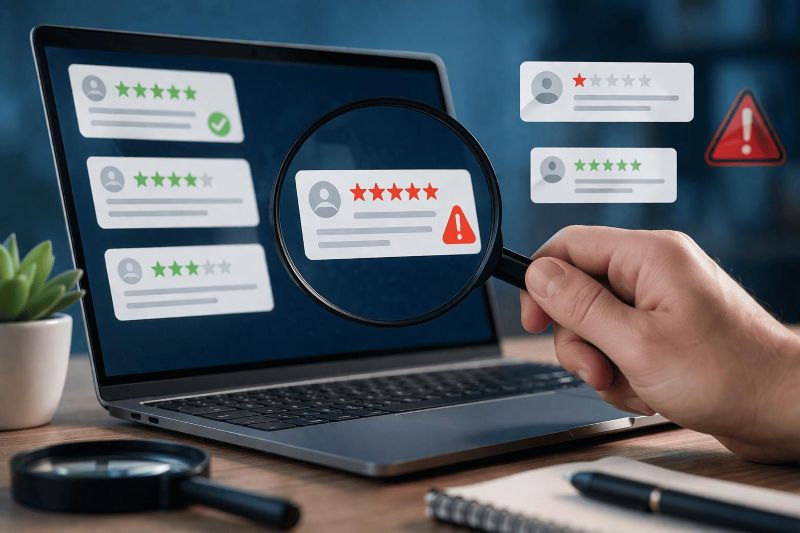
Buying Reviews: How to Spot Fake Reviews
6 min read
1198 words
Online reviews can make or break a business. Before hiring a contractor, choosing a service provider, booking a hotel or purchasing a product, many consumers check what other people have said. That makes reviews valuable. It also creates an incentive for some businesses to manipulate them and create fake reviews.
What Does Buying Reviews Mean?
Buying reviews means paying someone to post feedback about a business, product or service when that person may not have actually been a customer. The purchased review might appear positive and enthusiastic, creating the impression that a business has more satisfied customers than it really does. There is another form of review manipulation that consumers should know about: fake negative reviews. These may be posted to damage the reputation of another business. The common problem is that the information is presented as genuine customer feedback when it may not be.
Why Fake Reviews Matter
Reviews are intended to help consumers make informed choices. If someone chooses a business because of hundreds of supposedly genuine five-star experiences, those reviews can influence where they spend their money. When some of that feedback is manufactured, consumers lose an important piece of information. It can also make it more difficult for smaller businesses that have built their reputations through actual customers to compete with companies that artificially inflate their ratings.
How to Spot Suspicious Reviews
There is no single test that can prove a review is fake. A genuine customer may leave a one-line comment, create an account specifically to write a review, or have nothing else on their profile. Instead of judging individual reviews, look at the evidence surrounding them.
1. Check When the Reviews Were Posted
Review dates can reveal unusual activity. Imagine a business receives a small number of reviews over several years and then suddenly receives a very large number within a few days. That doesn’t prove anything by itself. A business might have launched a promotion, received media attention or experienced a major increase in customers. Still, an unexplained change in the normal pattern is worth investigating.
2. Compare the Writing
Read several reviews together. Do different customers use remarkably similar phrases? Are the reviews structured almost identically? Do they repeatedly mention the same features in the same way? A collection of comments that sounds as though it came from a template can be more concerning than a single enthusiastic review.
3. Look for Real Details
Useful reviews usually tell you something about the customer’s experience. A detailed review might explain what the person purchased, what problem they needed solved, how the service was handled or what happened when something went wrong.
By comparison, a large collection of comments saying little more than “Amazing!” or “Highly recommend!” provides very little information. Short reviews are not automatically fake. The issue is whether the entire review profile offers meaningful customer experiences.
4. Examine Reviewer Profiles
Some review platforms provide information about the people leaving reviews. When available, check whether an account has a history of reviewing businesses.
Be cautious when you see unusual activity, such as an account that appears to have been created recently and immediately posts numerous reviews for unrelated businesses. A person with only one review isn’t necessarily suspicious. They may simply not use the platform often.
The important question is whether the account’s activity makes sense.
5. Check Whether the Details Are Accurate
A reviewer may mention a service, product, employee, location or feature. Compare those claims with information provided by the business.
If a review describes something the company doesn’t offer, refers to a location that doesn’t exist, or contains details that clearly don’t match reality, that’s a more significant warning sign.
6. Read the Lower-Rated Reviews
Don’t limit your research to five-star comments. Two- and three-star reviews can sometimes provide more useful information because they may explain both positive and negative aspects of the experience. Look for recurring issues.
For example, if several unrelated customers describe the same problem with communication or billing, that information may be worth considering even when the overall rating is high. Also see whether the business responds to criticism and provides relevant information.
What Doesn’t Prove a Review Is Fake?
It’s easy to become suspicious of reviews for the wrong reasons.
These things do not automatically mean a review is fake:
- Poor spelling
- Excellent grammar
- A five-star rating
- A one-star rating
- A very short review
- A very detailed review
- A newly created reviewer account
- Someone who has only written one review
People have different writing styles and use review platforms differently. The strongest clues come from several unusual characteristics occurring together, rather than one isolated detail.
Don’t Judge a Business by Its Star Rating Alone
A 4.9-star rating may look impressive, but the number doesn’t tell you why customers gave those ratings.
Before making a decision, consider the quality and consistency of the feedback.
Ask yourself:
- Are the reviews spread over time?
- Do they describe actual experiences?
- Do customers independently mention similar strengths or problems?
- Does the business respond professionally?
- Does the information in the reviews match what the business actually provides?
These questions can give you a much clearer picture than the star rating alone.
Asking for Reviews Is Different From Buying Them
There is nothing inherently unusual about a business asking genuine customers to share their experiences. A company may send a follow-up email, provide a review link or remind customers that feedback is welcome. That’s very different from paying people to pretend they were customers. Businesses should also follow the rules of whichever review platform they use, particularly when offering incentives or requesting feedback. The safest approach is straightforward: encourage real customers to provide honest feedback.
What Businesses Gain From Genuine Reviews
A legitimate review provides more than a star rating. It gives potential customers an opportunity to learn how a business handles real situations. It can also show a business where customers are satisfied and where improvements may be needed. Rather than purchasing praise, businesses can build their reputation by providing dependable service, communicating clearly and dealing professionally with complaints. That reputation may take time to develop, but it is based on something consumers can actually evaluate.
What Consumers Should Do Before Choosing a Business
If online reviews are an important part of your decision, take a few minutes to investigate.
- Read recent and older reviews.
- Look beyond the five-star comments.
- Check specific details.
- Look at reviewer activity when available.
- Pay attention to unusual changes in review activity.
- And if something doesn’t add up, do more research before spending your money.
You can also look for other forms of information, such as the business’s website, social media presence, professional credentials where applicable, and recommendations from people you personally trust.
The Bottom Line
Online reviews can be extremely useful, but they should be treated as one source of information rather than unquestionable proof. Buying reviews can distort a business’s reputation and make it harder for consumers to determine what other customers actually experienced. You don’t need to assume that every glowing review is fake. Instead, look at the dates, language, reviewer activity, factual details and overall consistency. The more evidence you consider, the better equipped you are to separate useful customer feedback from questionable review activity.