Looksmaxxing Dangers: From Skincare to Bone Smashing
5 min read
957 words
If you’ve been on social media at all in the past few months, you’ve probably seen a transformation video, a tutorial about “mewing,” or a chat about “canthal tilts.” What began as a small part of the internet focused on basic grooming—”Looksmaxxing”—has now become super popular. By early 2026, the search interest for the term “Looksmaxxing” has jumped by more than 30%. What used to be just a bunch of advice on skincare and fitness has turned into something way more serious, and in many cases, it can change lives. Today, we’re exploring the growth of this online craze, the science behind it, and why the risks linked to the “hardmaxxing” trend are raising major alarms among health experts.
The Aesthetic “Declutter”: A Quest for the Perfect Face
We’ve all heard of the “minimalist” movement—the idea that decluttering our homes will finally bring us peace. Today, that same psychological pressure is being applied to the human face. Many young men are being sold the lie that they must “declutter” their features through surgery or trauma to find self-worth.
In 2026, the digital world is more visual than ever. With AI-enhanced filters and high-definition social feeds, there is an unspoken pressure to look “optimized.” Just as we might throw away old furniture to achieve a certain “aesthetic,” young men are viewing their own bone structure as something that can be edited, filed down, or augmented. This psychological shift highlights the hidden looksmaxxing dangers as self-care moves away from health and toward extreme engineering.
Quick Reference Guide: The Looksmaxxing Glossary
Softmaxxing: The entry-point. Includes skincare, trendy haircuts, hygiene, and hitting the gym. Generally the “safe” zone.
Hardmaxxing: The “danger” zone. Involves invasive procedures, including cosmetic surgeries, jaw implants, and “bone smashing.”
Hunter Eyes vs. Prey Eyes: An obsession with “canthal tilts” (the angle of the eye). “Hunter eyes” are almond-shaped and hooded; “prey eyes” are rounded and perceived as “weak.”
Mewing: A tongue-posturing technique intended to reshape the jawline. Often acts as a “gateway” to more extreme practices.
What is Bone Smashing?
One of the most alarming trends of 2026 is bone smashing. This is the practice of intentionally causing blunt-force trauma to the facial bones—specifically the cheekbones or jawline—using hammers or weights.
The theory is based on a misunderstanding of Wolff’s Law, which states that bones adapt to the loads under which they are placed. Users believe the bone will heal back thicker. In reality, medical professionals warn that this is one of the most severe looksmaxxing dangers, leading to:
- Fractures that heal improperly and cause bone spurs.
- Permanent nerve damage and facial numbness.
- Asymmetry that requires expensive reconstructive surgery.
The Risks of Hardmaxxing
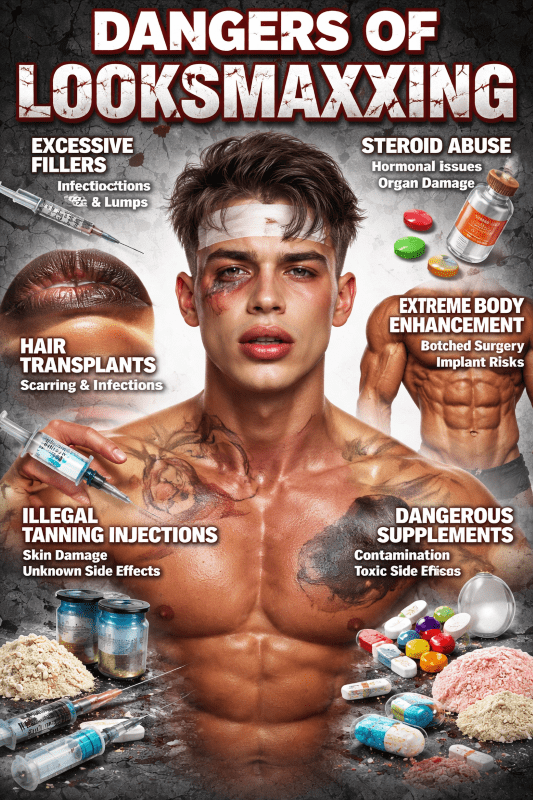
While “Softmaxxing” can have health benefits, “Hardmaxxing” carries looksmaxxing dangers that extend far beyond the physical:
The Surgical Rabbit Hole: Often driven by Body Dysmorphic Disorder (BDD), where one surgery is never enough.
Permanent Complications: Risks of infection, implant rejection, and permanent loss of sensation.
The Financial Drain: These procedures can cost tens of thousands, leaving young men in debt.
Psychological Isolation: The community often thrives on “rating” faces with brutal honesty, leading to severe social anxiety.
What the Experts Are Saying
Medical professionals across Canada and the U.S. are sounding the alarm on the clinical misinformation and looksmaxxing dangers spread in online forums.
- On Bone Smashing: Dr. Edward S. Kwak, a facial plastic surgeon, warns that blunt trauma to the face doesn’t “remodel” bone but instead causes permanent nerve damage and fractures. He notes that the “swelling” users see and mistake for “gains” is actually a dangerous injury response.
- On Mewing: The American Association of Orthodontists (AAO) has issued formal warnings, stating there is no scientific evidence that tongue placement can reshape an adult jawline. They warn that “DIY orthodontics” can lead to loosened teeth, speech impediments, and misaligned bites (TMJ).
- On Mental Health: Kyle T. Ganson, a professor at the University of Toronto specializing in eating disorders, notes that the trend creates “tunnel vision” where young men internalize an impossible ideal, leading to severe depression and suicidal ideation.
Pro-Tips: How to Talk to Your Son About Looksmaxxing
If you’ve noticed your teen using terms like “negative canthal tilt” or spending hours “mewing” in the mirror, it’s time for a supportive conversation.
Don’t Dismiss It: Avoid laughing at the terms. To them, this is serious social currency. Instead, ask, “I’ve been reading about Looksmaxxing—what do you think of those trends?”
Focus on Science, Not Appearance: Instead of saying “You look fine,” talk about the biology. Point out that “bone smashing” causes scar tissue and inflammation, not model-like bone growth.
Deconstruct the Algorithm: Explain how social media feeds them more of what they look at. If they click one video, their entire feed will soon make the trend seem more “normal” than it actually is.
Encourage “Soft” Over “Hard”: Redirect the energy toward healthy habits. Support their interest in the gym or a good skincare routine, while setting a firm boundary against “trauma” or surgery.
Identify the “Declutter” Fallacy: Remind them that peace of mind doesn’t come from “fixing” a face. Just as a clean house doesn’t fix a stressful life, a “perfect” jawline won’t fix internal insecurities.
Final Thoughts
Self-improvement is an admirable goal, but the jump from grooming to medical self-harm is a line that should never be crossed. In 2026, the most important “maxxing” any young person can do is Mindmaxxing—developing the mental resilience to see through the digital smoke and mirrors and find value in who they are, rather than how they are shaped.