
5 min read
946 words
Operational flow in busy facilities is influenced by consistency rather than speed alone. Work moves smoothly when every interaction within the space behaves as expected, without delay or variation. Disruptions rarely originate from a single failure. They emerge through repeated inefficiencies that gradually alter how tasks are carried out. A slight pause at an entry point, a moment of uncertainty at a control interface, or minor congestion in a shared zone can, over time, influence how teams coordinate and how work progresses across different stages.
Maintaining that level of consistency requires attention to the systems and areas that experience the highest frequency of use. Entry systems, loading zones, control interfaces, and environmental conditions operate as foundational elements within the facility.
Keeping Entry Systems Responsive
Entry systems function as continuous access points for both personnel and materials, making their responsiveness essential to maintaining operational continuity. In facilities where movement is constant, even minor delays at these points can introduce inefficiencies that extend beyond the immediate interaction. A garage door that opens slower than expected or requires repeated input can create brief pauses that accumulate across multiple cycles of use, particularly in high-traffic conditions.
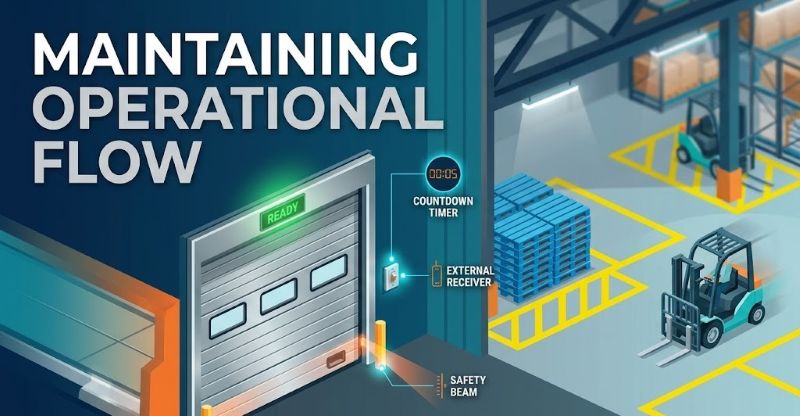
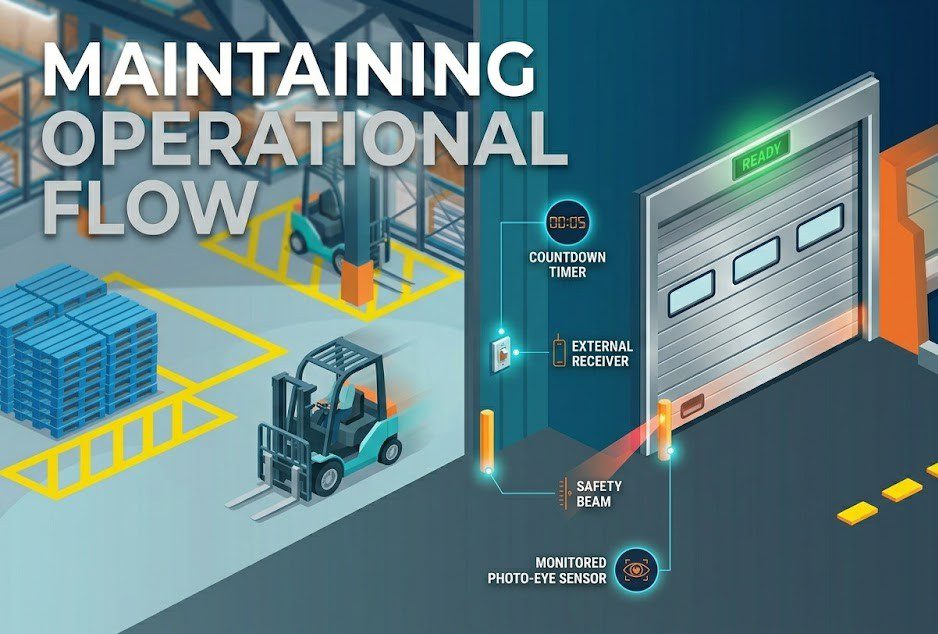
The integration of support components, such as garage door accessories, plays a key role in maintaining consistent performance at these entry points. Including monitored retro-reflective photo-eyes, safety beams, external receivers, egress switches, and countdown timer displays contributes to a system that responds immediately and maintains consistent performance under repeated use. In environments with frequent vehicle movement, such responsiveness allows entry systems to operate in alignment with workflow demands, reducing the need for manual correction and minimizing interruption during repeated use cycles.
Keeping Loading Zones Clear
Loading and unloading areas represent concentrated points of activity within a facility, where materials transition between stages of processing. These zones must accommodate both movement and temporary holding, which makes their organization critical. Without a structure, even a small degree of congestion can affect equipment operation, delay handling times, and create overlap between tasks that were intended to remain separate.
Maintaining clarity requires defined pathways, designated staging areas, and consistent spatial discipline. When incoming and outgoing materials are clearly separated, and movement paths remain predictable, equipment operators can perform tasks with greater efficiency.
Simplifying Control Systems
Control systems are engaged repeatedly throughout the operational cycle, often under conditions that require quick and accurate input. Their design and usability directly influence how efficiently tasks are executed. When systems present complexity or inconsistency, operators may experience brief hesitation as they confirm inputs or adjust to varying layouts.
A simplified and consistent control interface supports smoother interaction. Properly labeled inputs, uniform system behavior, and predictable responses enable operators to act with confidence and without interruption. This reduces cognitive load and allows attention to remain focused on the task itself rather than the mechanism controlling it.
Monitoring High-Use Access Points
High-use access points serve as indicators of overall system performance due to the frequency with which they are engaged. These areas are subject to accelerated wear and are more likely to exhibit early signs of inefficiency. Without regular monitoring, subtle changes in performance may go unnoticed until they begin affecting multiple aspects of the workflow.
Ongoing observation of these points provides valuable insight into system behavior. Tracking elements such as response time, alignment, and operational consistency allows for early identification of deviations from expected performance.
How Lighting Influences Operational Flow
Lighting conditions play a critical role in supporting both the speed and accuracy of operations. Inadequate or uneven lighting introduces uncertainty in visual tasks, which can slow movement and increase the likelihood of errors. This is particularly relevant in areas where precise handling, identification, or navigation is required.
Consistent and well-distributed lighting improves visibility across all operational zones. In environments such as loading docks, storage areas, and access points, proper illumination allows workers to perform tasks with confidence.
Keeping Emergency Pathways Accessible
Emergency pathways serve a dual function within busy facilities. They exist for safety, yet they also influence everyday movement patterns. When these pathways remain clear and properly maintained, they provide alternative routes that support flexibility during peak activity. When they become partially obstructed or inconsistently managed, they introduce uncertainty that can affect both routine operations and critical response scenarios.
Maintaining accessibility in these pathways requires consistent attention rather than occasional clearing. Storage overflow, temporary equipment placement, or unmanaged materials often find their way into these areas over time.
Maintaining Consistent Equipment Response Times
Equipment response time directly influences how predictably tasks can be completed. In environments where multiple teams rely on shared systems, even minor variations in performance can affect coordination. A system that responds instantly in one instance but hesitates in another introduces inconsistency, which forces operators to adjust their timing or approach.
Consistency in response is achieved through proper calibration, regular maintenance, and alignment with operational demand. When equipment performs within expected parameters every time it is used, tasks can be executed without hesitation. This predictability supports synchronized activity across different functions.
Maintaining Spatial Discipline Across Work Zones
Shared spaces within a facility require consistent spatial discipline to function effectively. When materials, tools, or equipment are placed without a structure, the space gradually becomes less predictable. This unpredictability affects how quickly tasks can be carried out and increases the likelihood of delays or errors.
Establishing and maintaining defined zones for specific functions supports clarity and efficiency. Materials remain where they are expected, pathways stay clear, and equipment operates within designated areas.
Maintaining operational flow across busy facilities requires consistent performance from both systems and spaces. It is shaped by how reliably each element responds under repeated use and how well different parts of the environment support one another.
 Victoria Jain
  Lisa
Lisa  Sierra Powell