
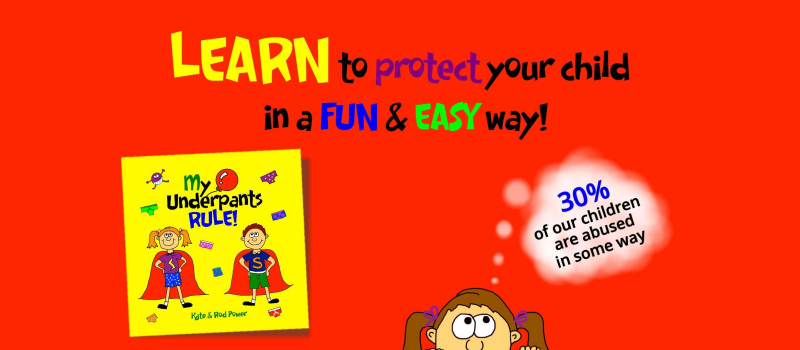
My Underpants Rule Empowering children’s book
7 min read
1325 words
For parents, discussing the realities of child sexual abuse (CSA) is perhaps one of the most daunting and emotionally taxing conversations we face. It requires confronting a difficult truth: the world is not always safe, and the people closest to our children are often the ones posing the greatest threat. However, silence is not protection. In fact, empowering our children with knowledge and vocabulary is the most critical preventative action we can take. Recently, as my husband and I navigated this sensitive territory with our own daughter, we realized the immense need for tools that simplify this complex topic without terrifying young minds. That journey led us to a truly exceptional resource written specifically for kids: “My Underpants RULE!” by former Australian police officer Kate Power and her husband, Rod Power. This book is more than just a story; it is a foundational guide for initiating life-saving talks about appropriate and inappropriate touching. If you are struggling to find the right words, this comprehensive review will explain why this book needs to be on every parent’s bookshelf.
Confronting the Statistics: The Urgent Need for Child Protection Education
Before diving into the solution, it is vital to acknowledge the scope of the problem. Sometimes, the sheer prevalence of child sexual abuse feels overwhelming, but these statistics underscore why early education—the kind that “My Underpants RULE!” facilitates—is not optional, but essential.
The Centers for Disease Control and Prevention (CDC) provides sobering data:
- 1 in 4 girls will experience sexual abuse before the age of 18.
- 1 in 6 boys will experience sexual abuse before the age of 18.
These are not just numbers; they represent millions of children whose childhoods are potentially marked by trauma.
The Disturbing Familiarity
Perhaps the most terrifying insight for parents is that strangers are rarely the primary threat. Data consistently shows that 85% of child sexual abuse victims are familiar with their abusers. These are often relatives, family friends, babysitters, teachers, or coaches—people who abuse trust and access.
This reality highlights a critical deficiency in safety models that focus solely on “stranger danger.” Our children need tools that help them identify uncomfortable or inappropriate behavior, regardless of who is performing the action. This is precisely where the clear, non-negotiable message of the Golden Underpants Rule steps in.
Introducing “My Underpants RULE!”: A Body Safety Tool for Young Minds
Kate and Rod Power, drawing on their professional experience and as parents themselves, recognized the need for a resource that translates complex concepts of privacy and consent into language a 4-year-old can understand.
“My Underpants RULE!” achieves this through a brilliant combination of engaging illustration and memorable, playful rhymes.
Why Playful Rhyme Works for Tough Topics
For children aged 4–8 (and even younger, down to ages 2 or 3), complex, fear-based warnings are often ineffective. They need simple, repeated, and positive affirmations. The authors intentionally use rhyming structures and vibrant, age-appropriate illustrations to hold attention and reinforce core lessons.
The structure ensures that the safety lesson isn’t frightening, but empowering. It gives children agency and control over their own bodies, making the conversation about body safety feel like a natural discussion about personal rights.
The Golden Rule: “What’s Under My Pants Belongs Only to Me”
The book’s central pillar is the Golden Underpants Rule: “What’s under my pants belongs only to me.”
This deceptively simple statement is revolutionary in its clarity. It provides a concrete, non-abstract boundary marker for children.
Key Concepts Clarified in the Book:
- Private Parts: The book clearly defines which parts of the body are private and should not be touched by anyone else, except in necessary circumstances (like a doctor or parent for hygiene, always in a way that respects the child’s feelings).
- Appropriate vs. Inappropriate Touching: Using scenarios relevant to a child’s life, the book helps differentiate between a safe, appropriate hug from a trusted family member (if the child consents) and any form of touch that feels confusing, uncomfortable, or wrong.
- The Power to Say NO: The book repeatedly reinforces that a child’s feelings are valid, and they have the absolute right to refuse any touch that makes them feel uncomfortable—even if the person is an authority figure or someone they love.
Empowering Autonomy: Teaching Children It’s Okay to Say NO
While “My Underpants RULE!” focuses on safeguarding private parts, its greatest asset is its role as a springboard for discussions about body autonomy and consent.
In the broader context of teaching children safe boundaries, parents need to solidify the message that their child’s body belongs only to them. This autonomy must extend beyond protection from abuse and into everyday interactions.
Navigating Relational Touch
One challenge many parents face is managing well-meaning but non-consensual interactions within the family, especially around holidays or large gatherings. The well-intentioned insistence that a child “Give Auntie a hug” or “Kiss Grandma goodbye” teaches children that their body boundaries can be overridden by adult expectations or obligation.
We strongly echo the sentiment explored in the CNN article, “I Don’t Own My Child’s Body,” which argues that forcing physical affection teaches children two dangerous lessons:
- That they must ignore their instincts to please an adult.
- That adults have superior authority over their physical choices.
By using “My Underpants RULE!” as a starting point, parents can teach their children:
- Your body is your own: If a relative wants a hug and you don’t want to give one, it is completely okay to offer a wave, a high-five, or a verbal “I love you” instead.
- Your feelings matter: Any touch that makes you feel “funny,” “scared,” or “uncomfortable” is a red flag, and you must tell a trusted adult immediately.
Reinforcing this personal power gives children the psychological tools to recognize and reject inappropriate contact when it genuinely occurs.
Practical Application: How to Use the Book Effectively
Reading “My Underpants RULE!” once is a great start, but its true power lies in its continued use as a dialogue starter. Parents should use the book’s clear language and scenarios to establish family rules about touch and secrets.
Beyond Reading: Scenario Planning (H3)
The book provides excellent scenarios, but parents can expand on these discussions:
| Scenario Topic | Parent Discussion Prompt | Body Safety Rule Reinforced |
|---|---|---|
| The Uncomfortable Secret | “If someone tells you, ‘This is our special secret, and you can’t tell Mommy,’ what should you do?” | Rule: Good secrets make you feel happy; bad secrets make you feel worried. You must always tell me bad secrets. |
| Necessary Touching | “If the doctor needs to check your private parts, what is the right way for them to do it?” | Rule: A trusted adult (parent) must be there, and the doctor must explain everything they are doing. |
| Saying No to Family | “If Auntie wants a hug but you just want a high-five, what words can you use to tell her respectfully?” | Rule: Your body belongs to you. You can choose how you touch, and you can change your mind. |
The Importance of the “Trusted Adult”
Crucially, you must clearly identify 3–5 safe, trusted adults your child can always turn to, should they need to report something that made them feel uncomfortable. This network should include people outside the immediate family (e.g., a teacher, a neighbor, or a grandparent) who they are comfortable approaching.
Taking Action: Our Strong Recommendation
While no book or single conversation can guarantee prevention, “My Underpants RULE!” is one of the most proactive and developmentally appropriate tools available today for teaching body safety and appropriate touch to young children.
It empowers without instilling fear, providing children with a simple, memorable rule that serves as a powerful psychological boundary. We wholeheartedly recommend this book to all parents, caregivers, and educators as the essential starting point for these critical conversations.
Parents who are looking for concrete, positive ways to introduce the concept of the Golden Underpants Rule will find this resource invaluable. It turns a conversation fraught with anxiety into an opportunity for empowerment and education.




Thanks for the introduction to this book,I have to say it’s one we need in our library!