How to Spot Real Shopping Deals: Is It a Deal?
12 min read
2378 words
Finding real shopping deals isn’t always as easy as seeing a sale sign or a lower price. You walk into the grocery store for one jar of pasta sauce. You know which one you want, and you know it usually costs around $3.
Then you see the sign: 3 for $10.
Suddenly, you’re standing there doing the math. Do you buy one? Three? Is it actually cheaper? And if you buy three, will you really use them?
The same thing happens online. You’re browsing Amazon and come across something you weren’t planning to buy. The price is $99, but beside it is a crossed out $149. There’s a coupon underneath and a message telling you the deal won’t last forever.
It looks like a bargain.
But is it?
Retailers know that shoppers love a good deal. Seeing a lower price, a percentage discount or a “buy more and save” promotion can make us feel like we’re getting something for less than it’s worth.
The problem is that a sale price doesn’t automatically mean you’re getting a good deal.
Sometimes you are. Sometimes you’re simply being encouraged to spend more than you planned.
Why We Love a Bargain
There’s nothing wrong with wanting to save money. Comparing prices and taking advantage of legitimate sales can be a smart way to stretch a household budget.
But there’s a psychological reason sales can be so tempting.
When you see an item advertised as $149 and then marked down to $99, your attention immediately goes to the $50 difference. Instead of thinking, “Do I need this for $99?” you may start thinking, “I’m saving $50.”
That’s an important difference.
The $50 isn’t money you earned or received. It’s money you didn’t spend, assuming you actually needed the item in the first place.
If you weren’t going to buy the product at $99, spending $99 doesn’t save you anything.
The “3 for $10” Question
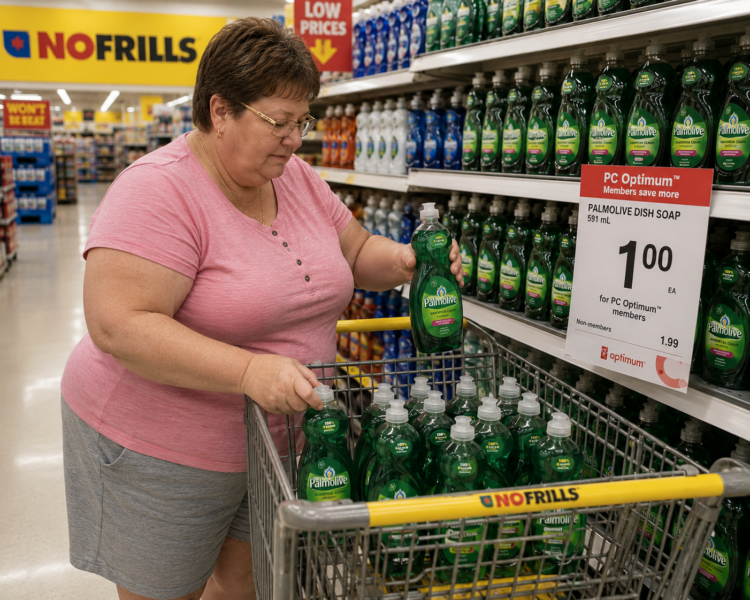
Multi buy promotions are everywhere in grocery stores.
You’ll see offers such as:
- 3 for $10
- 2 for $5
- Buy 2, Get 1 Free
- 10 for $10
- Buy 5 and Save
Sometimes these are genuinely good deals. Other times, they encourage you to buy more than you intended.
Let’s go back to our pasta sauce.
If one jar normally costs $3.49 and three are advertised for $10, you’re saving 47 cents by buying three.
That’s not necessarily a bad deal if you were already planning to buy three jars.
But if you only needed one, spending $10 instead of roughly $3.49 means you’ve spent considerably more money today simply because the promotion was there.
You haven’t really saved money on your grocery bill. You’ve increased it.
Do You Actually Have to Buy Three?
This is where reading the shelf tag matters.
Some stores will give you the promotional unit price even if you buy fewer items, while other promotions require you to purchase a specific number to receive the discount. The terms vary by retailer and promotion.
Don’t assume.
Look at the fine print or ask an employee before putting three items in your cart.
And don’t forget to compare the promotional price with the regular unit price. Sometimes the difference is surprisingly small.
If you’re trying to find real shopping deals, the advertised number isn’t always the number that matters most. You need to know what you’re actually paying for each item.
Look at the Unit Price
One of the best ways to determine whether you’re getting a grocery deal is to check the unit price on the shelf label.
The large sale sign might say:
3 for $10
But the smaller information on the shelf may tell you what the product costs per 100 grams, 100 millilitres or another standard measurement.
That’s the number worth paying attention to when you’re comparing different sizes or brands.
For example, a large package isn’t automatically the better value. A family size box can sometimes cost more per unit than two regular boxes.
The same applies to multi buy promotions.
Do the math before assuming you’re saving.
A Bigger Bottle Isn’t Always Better, But Sometimes It Is
We’ve all heard that buying the larger package saves money. But that’s not always true. The only way to know is to do the math.
Take Tide Ultra Oxi Max liquid laundry detergent.
A 21 load bottle is priced at $5.99. That’s about 28.5 cents per load.
A larger 83 load bottle is $19.97, which works out to about 24.1 cents per load.
At first glance, the $5.99 bottle looks much easier on your wallet. But if you’re going to use the detergent regularly, the larger bottle is actually the better value.
To get approximately the same number of loads as the 83 load bottle, you’d need four of the 21 load bottles.
Four bottles at $5.99 each would cost:
$5.99 × 4 = $23.96
The 83 load bottle costs:
$19.97
That’s a difference of $3.99.
In this case, buying the larger bottle really does save money.
The lesson isn’t that you should always buy the biggest package. It’s that you need to compare the cost per load, unit or measurement before deciding which option is the better deal.
A smaller package may be the right choice if you don’t have room to store the larger one or don’t use the product very often. But if you know you’ll use it and have the storage space, the larger bottle can be the smarter buy.
Don’t assume bigger is better. Don’t assume smaller is cheaper. Do the math.
When Buying More Does Make Sense
Buying multiples isn’t always a bad idea.
If it’s something your household uses regularly, you have enough storage space and the price is genuinely lower, buying extra can make sense.
Toilet paper, paper towels, canned goods and other products with a long shelf life can be good candidates for stocking up.
But ask yourself three questions:
Would I buy this anyway?
Will I use it before it expires or becomes stale?
Do I have room in my budget for buying more today?
If the answer to any of those questions is no, the promotion may not be worth it.
The best real shopping deals are the ones that save you money on things you were already going to purchase, not the ones that convince you to buy things you don’t need.
What About Amazon Price Drops?
Online shopping creates a slightly different problem.
You may see something listed for:
$99
with a crossed out price of:
$149
and a message saying you’re saving 33%.
That certainly looks like a deal.
But the important question is:
Was the product actually selling for $149?
A crossed out price or “list price” isn’t necessarily a good indication of what shoppers have typically paid for the product.
Prices can change frequently online, and the reference price shown beside a current price may not tell you the whole story.
That’s why it’s worth looking at a product’s price history before assuming you’ve found a major bargain.
If you want to learn more about misleading Amazon discounts and price manipulation, see Black Friday: Amazon Shoppers Warned About Deals on Today’s Woman. The article explains how some sellers may increase prices before major sales events and why checking price history can help determine whether a discount is actually a bargain.
Amazon Deal Groups Can Help You Find Real Savings
Amazon deal groups on Facebook and other social media platforms can be useful when you’re looking for price drops. Members often share products they’ve found at a lower price, which can make it easier to spot sales you might otherwise miss.
But before you click “Buy,” it’s still important to check the details of the deal.
Here’s a simple example.
Suppose you see a Cottonelle deal for $8.93 for four flip top packs containing 168 wipes.
That sounds like a good price.
But here’s where you need to pay attention.
The promotional price may only apply to one four pack. If you want eight packages, you can’t necessarily assume that you can purchase two four packs for $8.93 each.
In this example, the first four pack costs $8.93. The second four pack is charged at the regular price of $10.98.
That means buying two four packs separately would cost:
$8.93 + $10.98 = $19.91
The eight package case, however, is $17.97.
That means the case saves you $1.94 compared with purchasing two four packs separately.
It’s not a huge saving, but it demonstrates an important point about online shopping.
You have to look beyond the advertised deal price.
A social media post might highlight the $8.93 price and make it sound as though you can simply double that price to get eight packages. But if the promotion only applies once, the calculation changes.
In this case, the larger case really is the better deal.
Check the Deal Before You Buy
When you see an Amazon deal shared in a Facebook group, check the actual Amazon listing before making your purchase.
Look at:
- How many items are included in the advertised price
- Whether the discount applies more than once
- The regular price for additional quantities
- Whether there is a quantity limit
- Whether a coupon needs to be clipped
- Whether Subscribe & Save is required
- The final price in your cart
A deal group can point you toward a good price, but you still need to make sure the promotion works the way you think it does.
Don’t assume the deal is good because someone posted it. Check the numbers yourself.
Sometimes the Deal Really Is Worth Considering
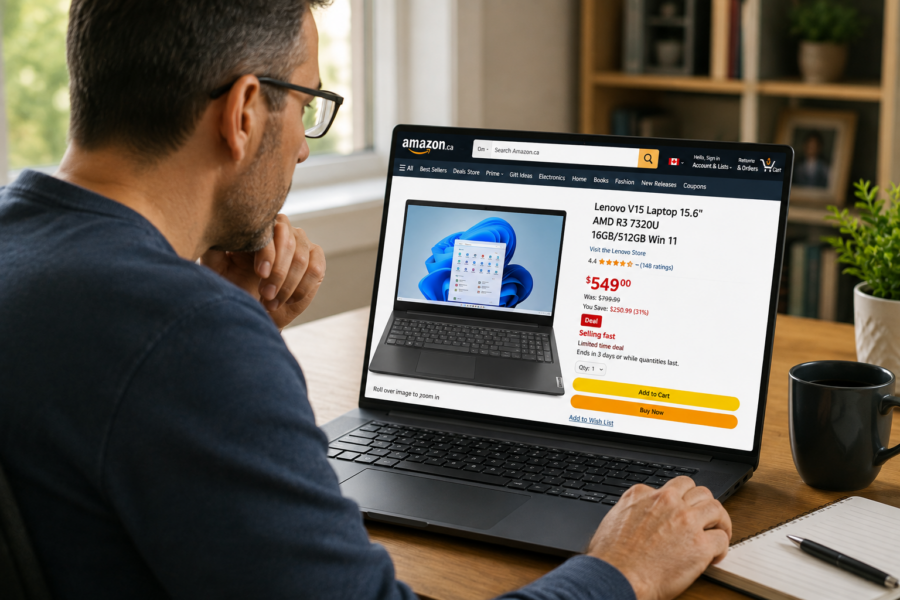
Not every sale is a gimmick. Sometimes you really are getting a competitive price, but you still need to know what you’re comparing.
Take the Lenovo V15 laptop as an example.
A configuration with a 15.6 inch display, AMD Ryzen 3 7320U processor, 16GB of RAM, 512GB SSD storage and Windows 11 is listed at around $549.
Is $549 automatically a great deal?
Not necessarily.
The price needs to be compared with similar laptops offering comparable specifications. A laptop with a more powerful processor, better display or additional features may cost more, while another laptop with similar specifications could cost less.
What makes this example interesting is that the specifications matter just as much as the sale price.
Sixteen gigabytes of RAM and a 512GB SSD are useful specifications for everyday computing, including web browsing, Microsoft Office, writing, video calls and multitasking.
But if you’re shopping for a laptop, don’t simply look at a banner saying “SALE” or a percentage discount.
Compare the processor, RAM, storage, screen, operating system, warranty and price with other laptops.
A $549 laptop isn’t necessarily a bargain simply because it was previously listed at a higher price.
It becomes a good deal when the computer you’re getting is worth $549 compared with your other available choices.
That’s an important distinction.
A sale isn’t what determines the value.
The product, the specifications and the price together determine the value.
Check the Price History
Several websites and browser tools track Amazon prices over time.
Tools such as CamelCamelCamel and Keepa can show historical pricing for many Amazon products.
Instead of simply looking at:
Was $149, now $99
you can see whether the product has actually been selling around $99 for months.
You might discover that $99 isn’t an unusual sale price at all.
Maybe the product was $99 last month.
Maybe it drops to $89 every few weeks.
Or perhaps $99 really is an unusually good price.
That information gives you a much better idea of whether you’re getting a deal.
Don’t Let a Countdown Make the Decision for You
Online retailers also use messages designed to create urgency.
You might see:
“Only 3 left!”
or
“Deal ends in 02:14:36.”
Sometimes the information is useful. If there really are only a few products remaining, you may need to make a decision.
But don’t let a countdown timer convince you that you need something you weren’t planning to buy.
If you need time to think, take it.
A product you don’t need isn’t a bargain simply because the price is temporarily lower.
Be Careful With Stacked Discounts
Online shopping can also make savings look more impressive than they really are.
You might see:
- A sale price
- A percentage off coupon
- A promotional code
- Subscribe & Save
- Free shipping
- A limited time offer
When several discounts appear on the same page, it can become difficult to determine what you’re actually paying compared with the normal price.
Before clicking “Buy,” look at the final price and ask yourself whether you would still consider it a good purchase without all the promotional messages surrounding it.
A Sale Isn’t a Saving If You Didn’t Need It
This is probably the simplest rule to remember:
If you weren’t going to buy it, buying it because it’s on sale isn’t saving money.
A $20 item marked down to $15 is still a $15 purchase.
If you needed the item and were already planning to buy it, the $5 reduction is a genuine saving.
But if you bought it simply because you didn’t want to miss the deal, you’ve still spent money that wasn’t in your original plan.
Five Ways to Tell If a Deal Is Worth It
1. Compare the unit price
Don’t rely on the large sale sign. Look at the price per unit or standard measurement.
2. Check the math
If something is advertised as 3 for $10, calculate what you’re paying per item and compare it with the regular price.
3. Look at price history online
Before assuming an Amazon discount is exceptional, check how much the product has actually been selling for.
4. Don’t buy extras just because they’re discounted
If you only need one, buying three isn’t automatically a better deal.
5. Give yourself time
If you’re shopping online and don’t need the item immediately, put it in your cart and come back later. You may decide you don’t want it after all.
The Best Deal May Be the One You Don’t Buy
Retailers aren’t doing anything unusual by advertising sales. Promotions are a normal part of shopping, and many offer legitimate savings.
The problem comes when we stop asking whether the promotion is actually useful to us.
Before buying something because the sign says SALE, 3 FOR $10, 33% OFF or LIMITED TIME, take a moment and look at the numbers.
What is the actual price?
What was the product selling for before?
How much are you saving?
Would you have bought it anyway?
And most importantly, do you actually need it?
A good deal isn’t simply something with a lower price attached to it.
It’s something you need, at a price you’re comfortable paying.
Sometimes the smartest bargain is putting the item back on the shelf or closing the Amazon tab and keeping the money in your wallet.