
Meta AI Training: What Happens to Your Private Facebook Messages?
7 min read
1367 words
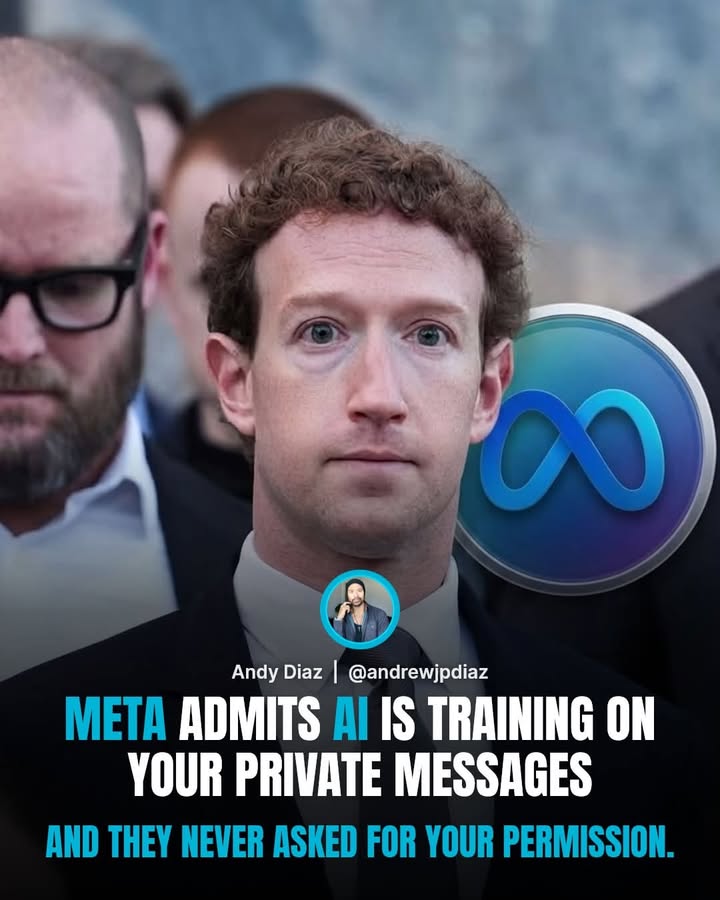
A viral social media graphic is raising concerns about online privacy with a startling accusation: Meta admits it is using private messages for Meta AI training without asking for permission. The post, which features Meta CEO Mark Zuckerberg alongside the company’s logo, suggests that Facebook, Instagram and Messenger users are having their private conversations used to develop AI without their consent.
The claim is alarming, especially for people who use social media to discuss personal matters with friends and family. But is it true?
The short answer is that the viral post is misleading. Meta says it does not use the content of private messages between friends and family to train its AI models unless someone in the conversation chooses to share those messages with its AI features. However, the company does use certain publicly shared content and information from people’s interactions with its AI tools to improve its technology.
Understanding the difference matters. Although the viral graphic raises a legitimate question about digital privacy, its wording leaves out important details about how Meta says its AI systems are trained.
What Does Meta Actually Say About Private Messages?
Meta has addressed this question in its official explanation of its generative AI features, titled Privacy Matters: Meta’s Generative AI Features.
The company states that it does not use the content of private messages between friends and family to train its AI models unless someone in the conversation chooses to share those messages with its AI features.
Meta clarified this explanation in updates published in 2025 and 2026, explaining that messages people choose to share with its AI tools may be used for training.
This distinction is important because a private conversation between two people is not the same as a conversation with an AI assistant.
For example, exchanging personal messages with a friend on Messenger is different from asking Meta AI to summarize a conversation, answer a question or help write a response. When people deliberately involve an AI feature, the information shared with that feature may be handled differently.
That does not mean users should ignore privacy concerns. It means the claim that Meta has admitted to secretly training AI on everyone’s private messages does not accurately reflect the company’s stated policy.
What Information Does Meta Use to Train Its AI?
Although Meta says it does not train its AI on ordinary private messages between friends and family, it does use other information to develop and improve its technology.
According to Meta’s published explanation, its AI training data can include:
- Public Facebook and Instagram posts: Publicly shared photos, text and other content have been used to train generative AI models.
- Public comments and other publicly available information: Information shared publicly may be included in AI training, depending on the applicable policies.
- Interactions with Meta AI: Information people share when interacting with Meta AI may be used to improve its products and AI systems.
- Information shared directly with AI features: Messages or other content that people choose to share with an AI tool may be used to train or improve its models.
The company has also explained that information shared with its AI features may be used to provide personalized responses and that some interactions may be reviewed by automated systems and people to improve performance and safety.
For users, the practical lesson is straightforward: something being private from the general public does not necessarily mean it is excluded from every form of data processing. The type of feature being used and the applicable privacy terms matter.
Is Meta Using Your Facebook and Instagram Photos?
Public social media content is another source of concern.
Meta has acknowledged using publicly shared Facebook and Instagram content, including photos and text, to train its generative AI models. This is different from accessing private posts or ordinary personal messages.
If you have shared photographs or posts publicly, that content may fall within the company’s AI training policies. The rules that apply to your account, location and the particular type of content can affect how your information is handled.
This is one reason it is worth reviewing your social media privacy settings. A public post can reach a much wider audience than a photograph or update shared only with selected friends.
Before uploading personal photographs, family information or other sensitive material, consider whether you are comfortable making that information publicly available.
Changing your account settings can help limit who sees future posts, but it is not a guarantee that information previously shared publicly has been removed from all systems in which it may have been processed.
What About Messenger and WhatsApp?
Many people use Messenger and WhatsApp for conversations they would never publish on a public social media profile. These services also have different privacy features, so it is important not to treat them as interchangeable.
WhatsApp uses end-to-end encryption for personal messages and calls, meaning the contents are designed to be readable only by the people communicating. Meta has also been developing optional AI features that process information users choose to submit.
For example, Meta announced Private Processing technology for certain WhatsApp AI features in 2025. The company says this technology is designed to process selected requests in a secure environment without allowing Meta or WhatsApp to access the message content.
In May 2026, Meta announced Incognito Chat with Meta AI, a separate feature intended to provide temporary AI conversations that even Meta cannot read. Its availability and rollout may vary.
These announcements do not mean every interaction with Meta AI has identical privacy protections. Users should check which feature they are using and read the relevant explanations before sharing sensitive information.
You can read Meta’s technical explanation of WhatsApp’s approach to AI privacy here: Building Private Processing for AI Tools on WhatsApp.
How to Protect Your Privacy When Using Meta’s Apps
You do not have to stop using Facebook, Instagram, Messenger or WhatsApp to take your privacy seriously. A few practical steps can help you make more informed decisions about what you share.
1. Review your Facebook and Instagram audience settings.
Check whether your posts and photographs are public or restricted to friends. Limit the audience for personal updates whenever appropriate.
2. Think before sharing information with Meta AI.
Treat an AI conversation differently from a private conversation with a trusted friend. Avoid entering passwords, financial account details, identification numbers or other highly sensitive information unless you fully understand the feature’s privacy protections and have a compelling reason to share it.
3. Read the privacy information for the feature you are using.
Meta’s Privacy Center provides information about its approach to privacy and the controls available across its products. Look specifically for information about AI interactions, data retention and how submitted information may be used.
4. Check your account’s privacy and security settings regularly.
Review who can see your posts, how people can find your account and which applications or services have access to your information. Settings and features can change as platforms introduce new products.
5. Be cautious with viral privacy warnings.
A post with dramatic wording is not necessarily evidence of a policy change. Before sharing a warning, look for an official announcement, a dated policy update or reliable reporting that confirms the claim.
The Bottom Line: Should You Be Worried?
The viral claim that Meta has admitted to training AI on everyone’s private messages without permission is misleading. Meta’s stated policy distinguishes between ordinary private conversations and information users deliberately share with its AI features.
However, there are still legitimate questions about how much personal information technology companies collect, how public content is used, how AI interactions are reviewed and how clearly these practices are explained to users.
Social media privacy is not simply a question of whether a company reads your messages. It is also about understanding what happens to information when you publish a photograph, comment on a post or interact with an AI assistant.
The best approach is to stay informed, check the original sources and think carefully about what you share online.
You should not have to rely on a frightening social media graphic to understand your privacy rights. Knowing the difference between a verified policy and an exaggerated claim is the first step toward making better decisions about your personal information.