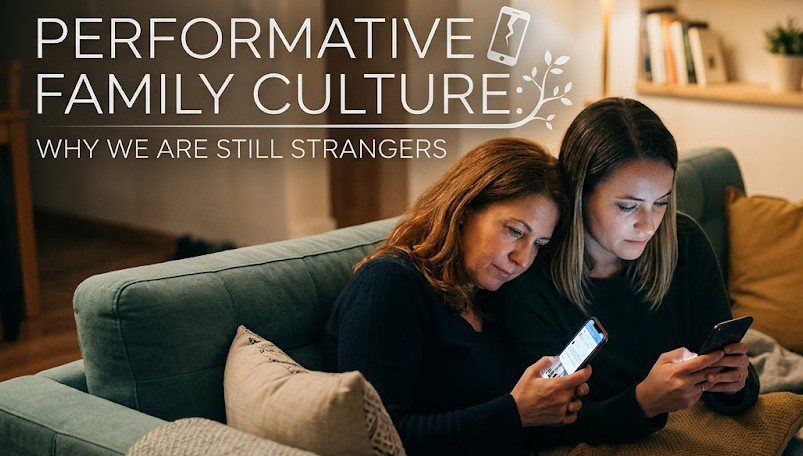
Performative Family Culture: Why We Are Still Strangers
5 min read
905 words
Imagine your sister walks through the front door after a year of being away. There is an initial embrace and a flurry of excitement. But thirty minutes later, the room falls into a strange, heavy quiet. You are sitting on the same sofa, but your eyes are anchored to your palms. You already know she had avocado toast at the airport because she posted it on her story. She tweeted about the airline because her flight was delayed. You feel as though you have already spent the day with her when, in reality, you have only spent it with her digital ghost. This is the silent room. It is a place many of us inhabit without even realizing it. Today, we often focus on how our families *appear* to be, preferring a polished image over the genuine, sometimes difficult, reality of relationships. This curated version looks great online but leaves us feeling empty.

The Exhaustion of the Curated Veneer
The psychological strain caused by the grid is a common experience. Before we even allow ourselves to live the moment, we spend hours thinking about framing, lighting, and finding the perfect filter. This habit creates a curated veneer that we feel forced to maintain. When we look at the highlight reels of our siblings or cousins, we naturally fall into a comparison trap. We start feeling that our own reality is somehow less than theirs, which leads to a cycle of over-performing.
Maintaining this flawless digital identity is exhausting. It is a form of mental labour that prevents us from being present. Our focus on online audiences makes us miss experiences with the people right beside us. This performative family culture tells us that if a moment was uncaptured and liked, it did not truly happen.
The Debt of a Perfect Image
This pressure does not just go through our minds; it drains our bank accounts, too. There is a deep link between social pressure and financial strain, especially during the holidays. We see the gorgeous trees and the perfectly coordinated outfits on our feeds, and we feel the need to buy the image. We overspend on gifts and decor, not because we can afford it, but because we want to maintain the aesthetic of a successful life.
We often use expensive gifts as a form of performative generosity. It is much easier to click “buy” on an expensive gadget than it is to carve out three hours for a difficult but necessary heart-to-heart conversation. We use the price tag to compensate for a lack of genuine time. Then January arrives, and we are left dealing with a literal debt for a perfect December that did not actually bring us any lasting joy.
When Liking Replaces Listening
The most dangerous part of our digital habit is the passive interaction trap. We see a cousin’s photo of a new grandchild or a sibling’s post about a promotion and we hit that little heart icon. We feel we have checked in. Because we have offered a double tap, we assume we have fulfilled our social obligation. We stop picking up the phone.
Digital breadcrumbs like short comments and likes have replaced the extended conversations that build real intimacy. We make dangerous digital assumptions. We assume a family member is doing fine because their feed is bright and colourful. Meanwhile, they might be drowning in a silent struggle that a photo can never capture. This brand of performative family culture makes us feel like we know each other when we are actually becoming strangers who happen to share DNA.
Breaking Through the Safe Topic Ceiling
When we finally do gather in person, we often find ourselves stuck under a ceiling of safe topics. We talk about the weather or the job or the kids. We avoid the real issues like mental health or grief or financial struggles because those things do not fit the perfect grid. We sweep the messy stuff under the rug to keep the peace for the sake of the photo opportunity.
Staying polite and superficial prevents the vulnerability required for true bonding. If we never move past the weather, we never truly see each other. To heal the divide, we have to be willing to break the performance and embrace the mess.
Reclaiming the Gap
At wellness centres, they focus on helping adults navigate the anxiety that stems from these digital dynamics. They believe that life is lived in the gaps between the photos. The goal is to choose authenticity over aesthetics. It is better to have one deep, uncomfortable conversation than to receive fifty likes on a family portrait.
To break free from performative family culture, we must make a conscious choice to put the phone in another room. We must ask the questions that do not have easy answers. We must be willing to be seen not as a curated profile, but as a whole human being.
Vulnerability is the only way to stop being a stranger to your own family. The next time your sister visits or your parents call, try to ignore the urge to check your notifications. Look them in the eye and ask a question that requires more than a one-word answer. You might find that the most beautiful parts of your life are the ones you never bothered to post online. Reclaiming your peace starts with ending the performative family culture and starting a real conversation.