Snowball-AI Method: How to Pay Off Student Loans in 2026
5 min read
851 words
Entering the workforce or managing a mid-career pivot in 2026 comes with a unique set of financial challenges. While the landscape of Canadian student debt has evolved, the burden of repayment remains a significant hurdle for many. However, a new approach is gaining traction: the Snowball-AI Method.
The Snowball-AI Method leverages advanced machine learning to accelerate your journey toward financial freedom. By combining the psychological momentum of the traditional “Debt Snowball” with the precision of modern technology, you can eliminate your balance years ahead of schedule.
Why Provincial Interest Rates Still Matter in Canada
Many borrowers are under the impression that Canadian student loans are entirely interest-free. While it is true that the federal portion of the Canada-Ontario Integrated Student Loan remains at 0% interest, the provincial side tells a different story.
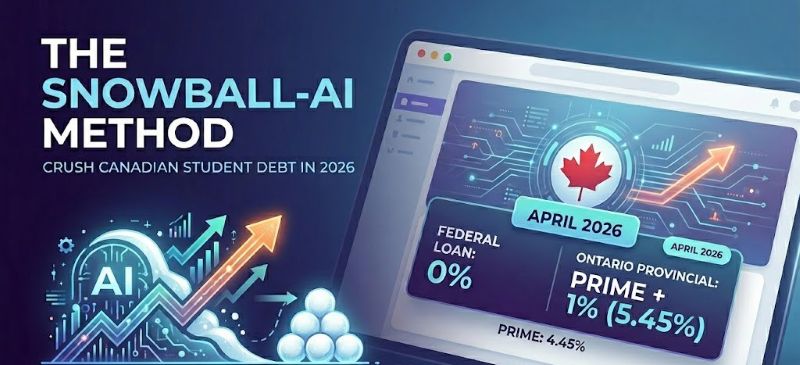
In 2026, Ontario student loan interest rates are a critical factor in your repayment timeline. Currently, the Ontario provincial portion of your loan carries a floating interest rate of Prime + 1%. With the Canadian prime rate currently sitting at 4.45%, your effective rate on the provincial share is 5.45%.
Ignoring this distinction can be a costly mistake. If you simply make the minimum consolidated payment, a portion of your money goes toward an interest-free federal balance while the provincial balance continues to accrue interest. To maximize efficiency, you must understand how to direct your funds where they have the most impact.
Using an AI Debt Payoff Strategy for Quick Wins
The debate of Debt Snowball vs. AI Optimization is the core of the 2026 financial planning landscape. The traditional Snowball method focuses on paying off the smallest balances first to build psychological momentum. While effective, it often ignores the underlying math of interest rates.
This is where the AI debt payoff calculator 2026 models come into play. Instead of just looking at the balance size, AI debt optimization analyzes your entire financial profile to pinpoint exactly which dollar should go to which debt.
By using an AI debt payoff strategy, you can achieve “Quick Wins” not just by closing small accounts, but by identifying the exact moment to pivot your strategy. For example, the AI might suggest paying off a small $500 credit card balance today (Snowball) but then immediately shifting all extra funds to the 5.45% provincial student loan interest rather than the 0% federal balance (Optimization).
The Information Architect Prompt for Budgeting
To make the Snowball-AI method work, you need high-quality data. Most people fail at budgeting because they suffer from Invisible Budget Leakage—those small, recurring $5 to $15 subscriptions and fees that go unnoticed but add up to thousands annually.
Knowing how to use Gemini for debt repayment starts with giving the AI a specific persona.
The “Information Architect” Audit Prompt:
“Review the following transaction history as a financial forensic auditor. Identify all recurring subscriptions, determine if there is any ‘Invisible Budget Leakage’ (fees or duplicate services), and categorize my spending into ‘Needs’ vs. ‘Wants.’ After the analysis, suggest a plan where I can redirect $200 per month toward my Prime + 1% Ontario Student Loans.”
The “Inflation Pivot”: Finding Debt Repayment Fuel
Managing a debt snowball in 2026 requires more than just a spreadsheet; it requires a lifestyle audit. With grocery prices soaring and Ontario gas stations peaking at $2.10/L this month, many borrowers feel their “extra” cash vanishing at the pump.
This is where the concept of the “Pivot” comes in. Instead of letting inflation stall your progress, you can adapt your lifestyle to protect your repayment goals. As discussed in our recent guide, Slow Road Trip: Why Gas at $2.10 Makes Summer 2026 the Year to Slow Down, choosing to explore local hidden gems instead of high-speed, long-distance travel can save you hundreds of dollars in a single month.
By applying that “Travel Surplus” directly to your interest-bearing provincial loans, you effectively turn a high-cost summer into a high-impact debt payoff season.
Conclusion: Managing Your 2026 Student Loan Balance

Managing your 2026 student loan balance requires a blend of technology and discipline to overcome rising costs of living. By focusing on the interest-bearing Ontario portion of your debt and using AI to prune your monthly expenses, you can turn a 10-year repayment plan into a 5-year victory.
Don’t just pay your bills. Optimize them. The Snowball-AI Method is more than a trend; it is the most efficient way to navigate the 2026 financial climate.
Frequently Asked Questions (FAQ) for 2026 Borrowers
What is the current interest rate for student loans in Ontario?
As of April 2026, the federal portion is 0%. The Ontario provincial portion is Prime + 1%. With the prime rate at 4.45%, your provincial interest is 5.45%.
Who qualifies for the Repayment Assistance Plan (RAP) in 2026?
The zero-payment income threshold for a single person is $40,000 annually. For a family of four, the threshold is $75,405 annually.
Can the Snowball-AI Method work with private bank loans?
Yes. Private loans often have the highest rates. AI optimization helps you determine when to switch from a “Smallest Balance” win to targeting high-interest private debt aggressively.
Is it better to pay off the provincial or federal portion first?
Always prioritize the Ontario provincial portion. Since the federal portion is interest-free, every extra dollar put toward the 5.45% provincial share saves you money immediately.