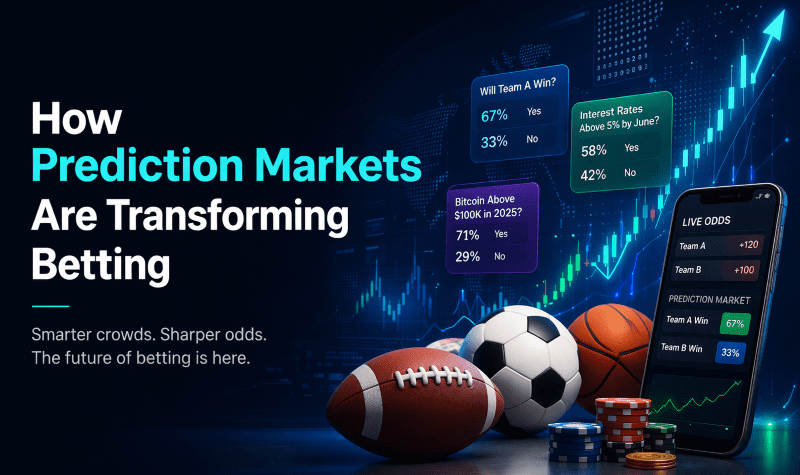
How Prediction Markets Are Transforming Betting
7 min read
1363 words
Prediction markets are attracting attention as technology changes how people follow sports, politics, financial developments, and other major events. Instead of simply reading forecasts or waiting for an outcome, participants can trade contracts linked to specific events, with prices changing as expectations shift.
This approach combines elements of forecasting, market analysis, and speculation. Supporters see prediction markets as a way to understand collective expectations, while critics raise questions about financial risk, regulation, and how accurately market prices reflect the likelihood of an outcome.
Understanding how prediction markets work can help readers make sense of this growing area of online activity and recognise the risks involved.
What Are Prediction Markets and Why Are They Growing?
Prediction markets allow participants to buy and sell contracts based on the outcome of a particular event. Depending on the platform, markets may cover sports results, political elections, economic indicators, or entertainment events.
In a simple yes-or-no market, a contract may pay a predetermined amount if a particular outcome occurs and nothing if it does not. Its current price reflects what participants are willing to pay, based on their expectations and the information available to them.
For example, if a contract that pays $1 when an event occurs trades at $0.60, its price may be interpreted as implying a 60 per cent probability. However, that figure is not a guarantee or necessarily an objective measure of the event’s true likelihood. Trading costs, market activity, and participants’ assumptions can all influence prices.
Interest in prediction markets has grown alongside digital platforms that make it easier to view market information and follow changing expectations. Their growing visibility has also prompted more discussion about how they differ from traditional betting and other forms of speculation.
The Shift From Traditional Betting to Market Participation
One difference between traditional betting and prediction markets is how positions may be managed.
In conventional sports betting, a person generally places a wager at the odds offered by a bookmaker. In some prediction markets, participants can buy or sell contracts as prices change, potentially closing a position before the event is resolved.
This creates opportunities to respond to new information, but it also introduces additional risks. A contract’s price can move in an unfavourable direction, and a participant may not be able to sell at the price they want.
Consider a sporting event in which an important player is injured. Participants may reassess the likelihood of a particular result, causing related contract prices to change. Those who follow the market may observe how expectations respond, but predicting the next price movement remains uncertain.
Although prediction markets can involve analysis and decision-making, greater participation does not necessarily mean better decisions or more successful outcomes. Financial losses remain possible.
How Online Platforms Make Prediction Markets Accessible
Digital technology has made it easier for people to access information about markets, review contract prices, and follow developments from their computers or mobile devices.
Many platforms use dashboards, charts, and simplified displays to help users understand available contracts. However, an easy-to-use interface does not remove the need to understand the underlying rules, costs, and risks.
When comparing prediction market platforms, readers should consider the available markets, fees, contract settlement rules, account requirements, and applicable regulations. They should also check whether the service is available to them in their location.
Those researching different services can learn more about FanDuel Predicts through its official website. Before participating, it is important to review the platform’s current terms, eligibility requirements, and risk disclosures rather than relying on promotional descriptions alone.
Data, Market Prices, and Decision-Making
One reason prediction markets attract interest is their ability to reflect changing expectations. When participants respond to new information, prices can move as their collective views evolve.
This process is sometimes described as aggregating information. Instead of relying on one person’s opinion, a market reflects the activity of many participants. The result can offer a useful perspective on what those participants collectively expect to happen.
However, market prices are not always accurate forecasts. Results can be influenced by limited trading activity, participant bias, incomplete information, and unexpected developments. A market with little activity may provide a less informative signal than one with substantial participation.
Election forecasting illustrates why context matters. Prediction market prices can change in response to polling, campaign developments, economic news, and other events. They should not automatically be treated as more accurate than polling averages or other forecasting methods. Each approach has its own limitations.
For readers interested in data and probability, observing how expectations change can be informative even without participating financially. It is important to distinguish between learning from market movements and assuming that those movements reveal what will happen.
The Social Side of Prediction Markets
Prediction markets can also become part of wider online conversations. People may discuss possible outcomes, share analysis, or compare their interpretations of breaking news and other developments.
These discussions can introduce readers to different perspectives, but social activity is not a substitute for reliable information. Popular opinions can be mistaken, and confident predictions are not necessarily well supported.
Before acting on a claim or forecast, it is worth checking the original source, considering alternative explanations, and recognising the difference between evidence and personal opinion.
Readers should also be cautious about sharing financial information or personal details in online communities. A discussion group or social media account should not automatically be treated as a trustworthy source of investment or betting advice.
Understanding the Risks of Prediction Markets
Prediction markets involve uncertainty, and participants can lose money. Understanding the risks is essential before using any platform that involves trading event-based contracts.
Some important considerations include:
- Price changes: Contract values can move quickly when new information becomes available.
- Trading costs: Fees and differences between buying and selling prices can affect the final result.
- Liquidity: Some contracts may have limited trading activity, making it difficult to exit a position at a desired price.
- Unexpected outcomes: Even a well-researched prediction can be wrong.
- Emotional decisions: Repeatedly reacting to market movements can lead to decisions that are not carefully considered.
No strategy can guarantee a profit. Anyone considering participation should understand how the contracts work, review the possible financial consequences, and avoid risking money they cannot afford to lose.
People who prefer to follow news and forecasts without financial exposure can still learn about probability and public expectations by observing market information without placing trades.
Regulation and Availability Vary by Location
Prediction markets do not operate under identical rules everywhere. Their legal treatment may depend on the jurisdiction, the type of contract, the provider, and the event involved.
A platform available in one country or region may not offer the same products elsewhere. Users should check the provider’s current eligibility requirements and consult relevant official regulatory information before opening an account or participating.
It is also important to understand the specific terms of a contract, including how the outcome is determined, when settlement occurs, and what happens if an event is cancelled or its result is disputed.
Because regulations and product availability can change, current official information is more useful than relying on outdated articles or social media discussions.
Are Prediction Markets Here to Stay?
Prediction markets have become a more visible part of the conversation about technology, forecasting, and online financial activity. Their ability to reflect changing expectations makes them interesting to people who follow current events and want to understand how others assess uncertain outcomes.
Their long-term development will depend on factors such as regulation, consumer protections, platform transparency, market participation, and public trust.
For now, prediction markets are best understood as one way of observing collective expectations, not as a dependable method of predicting the future or generating income.
Final Thoughts
Prediction markets combine event forecasting with market participation, allowing contract prices to change as people respond to new information. They can offer an interesting perspective on public expectations, but those prices are not guarantees of accuracy.
Anyone exploring this area should take time to understand the contracts, compare platform terms, check local requirements, and consider the possibility of financial loss. Approaching prediction markets with realistic expectations and a clear understanding of their limitations is more useful than assuming that greater engagement automatically leads to better decisions.