
4 min read
737 words
In the world of pickleball, your paddle is an extension of your arm. While many players focus on footwork or shot selection, the foundation of every great rally begins with one simple element: your pickleball grip.
Whether you are a newcomer learning how to hold a pickleball paddle for the first time or an advanced player looking to add more spin to your game, understanding grip mechanics is the fastest way to improve your control, power, and consistency.
1. Why Your Grip Matters
Your grip dictates the angle of the paddle face at the moment of impact. A slight adjustment can be the difference between a clean winner and a ball into the net. Proper pickleball grip techniques allow you to transition seamlessly between defensive dinks and aggressive drives, ensuring you maintain control regardless of the shot speed.
Common beginner mistake: Many players start with a “pan-handle” grip—holding the paddle like a frying pan. This limits your range of motion and makes backhand shots incredibly difficult.
2. The Basics: How to Hold a Pickleball Paddle
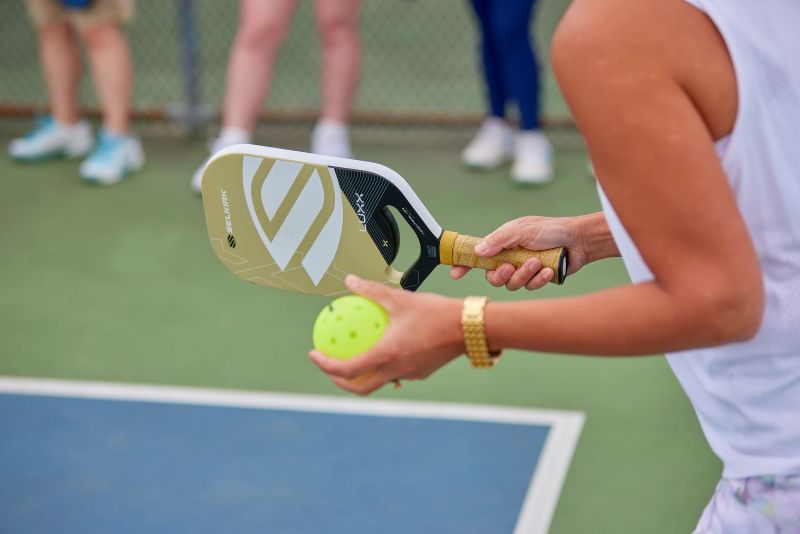
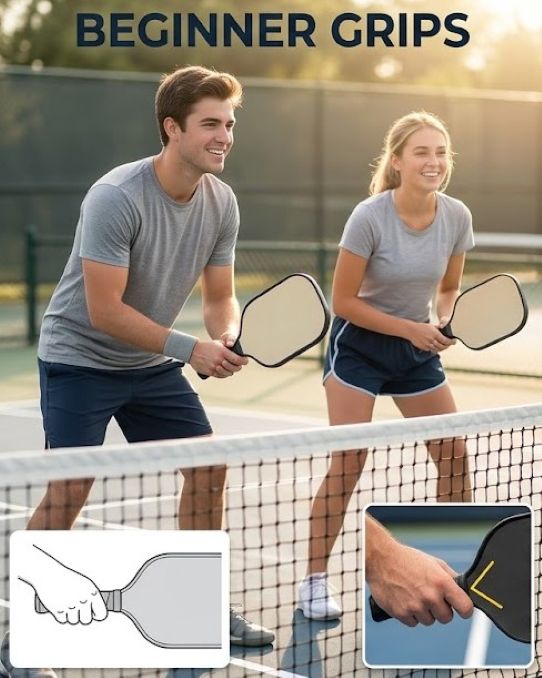
The standard starting point for almost every player is the “handshake grip.” Imagine you are reaching out to shake hands with your paddle handle. Your palm should rest comfortably against the side of the handle, with your fingers wrapped securely but not strangling it.
Grip Pressure: Think of your paddle as a delicate bird. If you squeeze too hard (10/10), you’ll be stiff and lose accuracy. If you hold it too loosely (1/10), the paddle will twist on impact. Aim for a 3–4/10 pressure during dinks and a 6–7/10 for powerful drives.
3. Main Pickleball Grip Types
a. Continental Grip (The Gold Standard)
The continental grip in pickleball is the most popular technique. By holding the paddle so the face is perpendicular to the ground, you create a versatile “neutral” position.
- Best for: Beginners, volleys, serves, and transition shots.
- Why: It allows for both forehand and backhand shots without needing to spin the handle as much.
b. Eastern Grip
The eastern grip is a slight rotation from the continental, often used for forehands. It provides a more “closed” paddle face, which generates more natural topspin and power. It is excellent for players who want to hit aggressive drives from the baseline.
c. Western Grip
A more advanced technique, the western grip involves rotating the hand further under the handle. This “closes” the paddle face significantly, making it ideal for high-spin shots.
- Pros: Incredible topspin.
- Cons: Very difficult to transition to backhands quickly.
4. Adjusting Your Grip for Different Shots
Pros rarely keep the same grip for every shot.
- Dinking & Soft Shots: Relax your grip pressure to increase “touch” or feel.
- Volleys at the Net: Keep the paddle in a neutral (continental) position so you can react quickly to both sides.
- Serves & Returns: You may firm up your grip to add momentum and pace to the ball.
5. Common Grip Mistakes to Avoid
- Over-tightening: This is the primary cause of “nerves” or “stiff arms,” leading to unforced errors.
- Static Grip: Never changing your grip during a rally. Being able to shift slightly for a backhand is a sign of an improving player.
- Ignoring Hand Fatigue: If your forearm is burning, check your grip pressure. You are likely holding the paddle too tightly.
6. Tips to Improve Your Pickleball Grip
- Drill with Purpose: During practice, focus solely on your hand position. Are you starting from the continental grip?
- The “Check-In”: Between points, check your grip pressure. Remind yourself to “relax” your hand.
- Use Overgrips: If your handle feels too thin or slick, apply an overgrip. This adds cushion, absorbs sweat, and ensures a stable hold in intense heat.
7. Choosing the Right Equipment
Your grip size matters. If the handle is too small, you will over-squeeze, leading to tension. If it’s too large, you won’t be able to snap your wrist effectively. Most standard paddles have a 4-inch to 4.5-inch circumference; test a few to find what feels ergonomic for your hand size.
Conclusion: Small Changes, Big Results
Improving your pickleball game doesn’t always require learning complex new strategies. Often, it simply requires refining your proper pickleball form. By mastering the continental grip and learning to modulate your grip pressure, you will immediately notice more stability in your volleys and more finesse at the kitchen line.
Start by practicing your handshake grip today. Focus on relaxation, stay consistent, and watch as your control improves on the court!
 Lynn Leblanc
  Jennifer Williams
  Debbie Price