How to Restore a Weathered Deck DIY: Step-by-Step Guide
4 min read
689 words
Is your deck looking gray, splintered, or worn down by the elements? You don’t need a professional contractor to bring your old wooden deck back to life. With the right technique, restoring an old deck on a budget is a rewarding project that adds value and beauty to your home.
Follow this DIY deck restoration step-by-step guide to transform your outdoor space from eyesore to oasis.
1. The Assessment: Inspect and Repair
Before you pick up a brush, ensure your deck is structurally sound.
Signs a deck board needs to be replaced:
- Deep Rot: Poke the wood with a screwdriver; if it sinks in easily, the wood is compromised.
- Severe Splintering: If boards are peeling in large layers, they won’t hold stain well and may be a safety hazard.
- Wobble: If boards are loose or warped beyond repair, it’s time to swap them out.
How to fix cracking deck boards:
For minor surface splits, use a high-quality exterior wood filler. For wider cracks, you may need to sand the edges to prevent further splintering. If structural integrity is compromised, prioritize replacing the board entirely before moving to the cleaning phase.
2. The Clean: Stripping and Washing
You cannot stain over old deck stain if it is peeling or failing. You must remove the previous finish to ensure the new product penetrates the wood fibers.
How to clean a wood deck without a pressure washer:
Many homeowners damage their decks by using too much pressure, which gouges the wood grain. Instead, use a deck stripper or a specialized wood cleaner. Apply the cleaner and scrub with a stiff-bristled brush. Rinse thoroughly with a garden hose. If you face stubborn mold, opt for the best deck cleaner for mold and mildew—usually a solution containing sodium percarbonate—to kill spores at the root.
3. The Prep: Sanding and Brightening
This is the “pro-secret” step most amateurs skip.
When to sand vs. chemical strip a deck:
Use a stripper to remove thick, failing paint or stain. Use sanding to smooth out fuzzy wood fibers and ensure a uniform surface.
Best sandpaper grit for deck restoration:
Start with 60-grit to remove surface imperfections and finish with 80-grit to open the wood pores for maximum absorption.
Deck wood brightener:
After stripping, the wood’s pH is often too high. Applying a wood brightener neutralizes the chemicals and restores the wood’s natural, golden color, effectively teaching you how to revive a gray wood deck instantly.
4. The Finish: Staining and Sealing
Choosing the right finish depends on your deck’s condition and your aesthetic goals.
Solid vs. Semi-Transparent Deck Stain for Old Wood
| Feature | Solid Stain | Semi-Transparent |
|---|---|---|
| Coverage | Excellent for hiding patches and cosmetic repairs. | Shows and accentuates beautiful natural wood grain. |
| Longevity | Lasts longer (typically 3 to 5 years). | Requires more frequent maintenance and reapplication. |
| Best For | Older, highly weathered wood with surface damage. | Newer or well-prepped, smooth wood surfaces. |
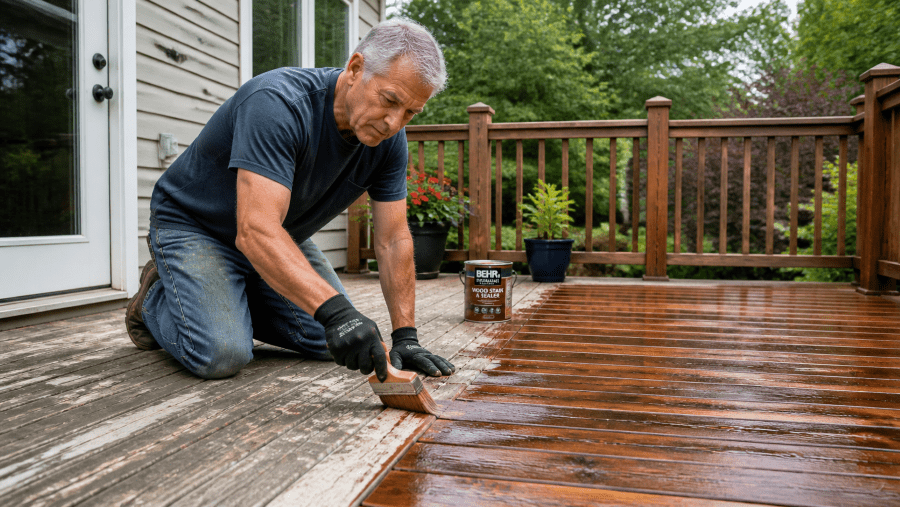
Trending Colors: For 2026, we are seeing a massive shift toward warm earthy deck stain colors. Consider a “coastal brown” semi-transparent stain for a natural, high-end look. To elevate your design, try a two-tone stained deck by using a solid color for the railings and a complementary semi-transparent tone for the decking boards.
Pro-tip: Use a natural bristle brush for oil-based stains and a synthetic bristle brush for water-based stains to ensure smooth application.
Frequently Asked Questions (FAQ)
Can you restore a deck in a weekend?
Yes, for a standard-sized deck. However, remember that drying time is critical—if the wood is still damp from cleaning, the stain will not adhere properly. Most projects take 2 to 3 days, including prep and drying time.
How long does a restored deck need to dry before rain?
You should aim for at least 24 to 48 hours of dry weather after applying your stain. Always check the manufacturer’s label on your specific product, as water-based stains may dry faster than oil-based alternatives.
Do I really need a brightener?
Yes. A brightener neutralizes the harsh chemicals used in stripping and opens the wood’s microscopic pores. Skipping this step often leads to the new stain peeling prematurely because it couldn’t penetrate deep enough into the grain.