
6 min read
1176 words
Back in the day, which was about five years ago for me, camping felt like a real endurance challenge. It was all about how many nights you could manage to sleep on a half-deflated air mattress and how much “campfire scent” (which really means hickory-flavored lung damage) your favorite hoodie could soak up before it turned into a health hazard. But now that we’re entering the 2026 season, the whole “weekend warrior” attitude is officially a thing of the past.
Welcome to the age of The New Wilderness.
From what I’ve seen, this change isn’t about leaving nature behind; it’s about using the technology of 2026 to enjoy it longer, more comfortably, and with a much smaller carbon footprint. We’re shifting from “escaping” our daily lives to “extending” them into the great outdoors. Whether you’re living in a van, prefer camping in a tent, or think that an RV without a wine fridge is “roughing it,” the rules have definitely changed.
The Solar Revolution: Death of the “Generator Guy”
We’ve all met him. “Generator Guy.” He arrives at a pristine lakeside campsite at 6:00 PM and immediately fires up a combustion engine that sounds like a lawnmower trapped in a metal trash can. In 2026, Generator Guy is socially persona non grata.
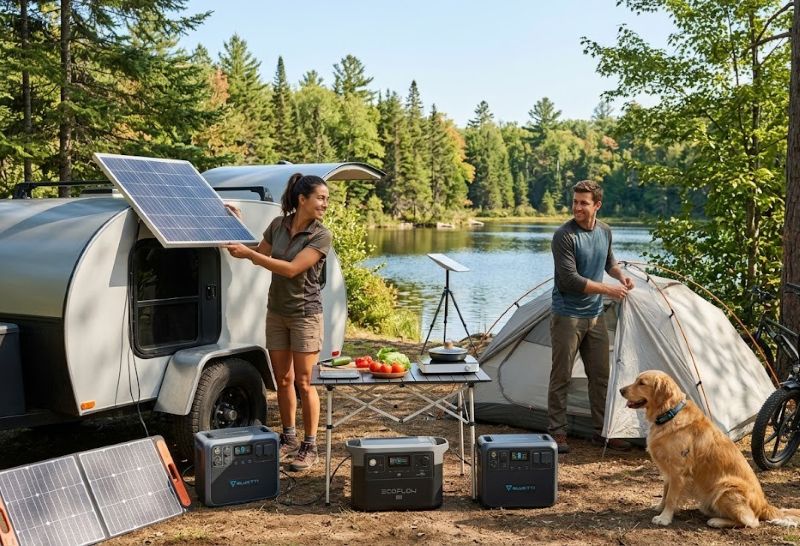
The trend for the 2026 season is quiet hours 24/7. Thanks to the massive leap in off-grid solar camping technology, silence is the new luxury. Campgrounds are increasingly banning internal combustion generators in favor of whisper-quiet portable power stations.
The Gear That’s Changing the Game:
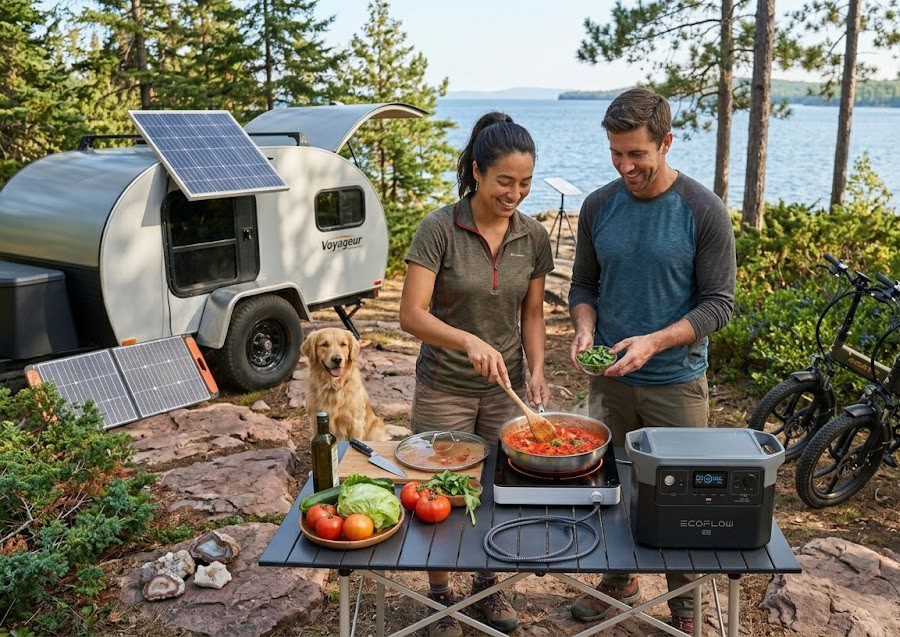
- Solid-State Battery Tech: In my experience, the switch from lithium-ion to solid-state batteries has been a total game-changer. They are lighter, charge in half the time, and don’t turn into a liability if the temperature drops below freezing.
- Flexible Solar Panels: Gone are the days of heavy, glass-framed panels. The 2026 camper uses ultra-thin, flexible panels that peel-and-stick to the roof of a van or the top of a tent.
- Induction Cooktops: Propane is so 2022. The “Zero-Emission Camp” is now a reality. Using a portable induction burner powered by your battery bank means no more “did I leave the gas on?” anxiety and no more heavy canisters to lug around. Plus, it boils water faster than you can say “sustainable camping 2026.”
The Digital Nomad Frontier: Starlink & “Work-from-Woods”
There was a time when “no bars” on your phone was a badge of honor. In 2026, “no bars” just means you’re missing a deadline. With the ubiquity of satellite internet—specifically the latest generation of Starlink—the Tuesday-to-Thursday workweek has officially moved to the lakeside.
Smart RV tech has evolved to include built-in signal boosters and integrated Starlink cradles that deploy with the push of a button. But being a “Work-from-Woods” (WFW) professional requires more than just a signal; it requires ergonomics. We’re seeing a surge in portable standing desks that hook onto tree trunks and sun-glare-resistant screens that actually allow you to see a spreadsheet while the sun is reflecting off a glacier.
However, a word of caution: in my experience, the hardest part of 2026 camping isn’t getting a signal—it’s knowing when to turn it off. The “New Wilderness” philosophy encourages digital boundaries. Use the fiber-optic speeds to finish your work by 3:00 PM, then put the laptop in its bear-proof sleeve and actually look at a tree.
Destination Trends: Beyond the National Park “Lottery”
If you tried to book a spot at Zion or Yellowstone recently, you know it’s harder than getting front-row seats to a Taylor Swift reunion tour. The 2026 season is defined by the “Under-the-Radar” movement.
Campers are ditching the national park lottery for eco-friendly glamping and private land opportunities.
- Agritourism: Why stay at a crowded KOA when you can book a stay on an alpaca farm or a private vineyard via apps like Hipcamp? In my experience, waking up to the smell of grapes (or the judgmental stare of an alpaca) beats a crowded parking lot every time.
- The Great Lakes Revival: Move over, West Coast. The “Third Coast” is having a moment. The backcountry loops around Lake Superior and the hidden gems of the Upper Peninsula are seeing a massive influx of travelers looking for cool breezes and freshwater solitude.
- State Park Superstars: Smart travelers are realizing that many State Parks offer the same jaw-dropping vistas as National Parks, but with 20% of the crowd and 100% more availability.
Gear Evolution: Lightweight, Modular, and Circular
The gear of 2026 isn’t just about being “tough”; it’s about being “circular.” The industry has moved toward sustainable camping 2026 standards, where “Leave No Trace” applies to the manufacturing process, too.
1. Circular Materials
We’re seeing tents and sleeping bags made from 100% recycled marine plastics. In my experience, these materials aren’t just eco-friendly; they’re actually more durable and water-resistant than the petroleum-based synthetics of the past.
2. Modular Kitchen Kits
The “chuck box” has been reimagined. Modern systems are modular, transitioning seamlessly from the trunk of a crossover SUV to a campsite picnic table. Everything nests, everything clicks, and everything is made of infinitely recyclable aluminum.
3. Pet-Friendly Outdoor Travel (The “Dog-First” Design)
Let’s be honest: your dog is the real trip leader. In 2026, gear companies are finally acknowledging this. We now have:
- Integrated Cooling Beds: Dog beds with phase-change cooling gel for those hot August nights.
- GPS-Tracked Safety: Collars that sync directly to your satellite hub, so even if Fido chases a squirrel into the next zip code, you can find him with sub-meter accuracy.
- Bio-Degradable Everything: From waste bags to portable bowls, the focus is on keeping the trail as clean as you found it.
The Future of the Great Outdoors
As we look toward the peak of the 2026 season, it’s clear that camping is undergoing a beautiful metamorphosis. It is becoming more accessible for those who need to work, more comfortable for those who want to stay longer, and more respectful of the landscapes we love.
The intersection of smart RV tech, off-grid solar camping, and a renewed focus on local, private-land destinations is making the wilderness feel “new” again. We aren’t just visiting nature anymore; we’re learning how to live within it without breaking it.
The Pro-Tip: Don’t wait for the mid-July heatwaves. In my experience, the “shoulder seasons” (late spring and early fall) are the sweet spots of 2026. The bugs are gone, the crowds are thin, and with your new solar-powered heated blanket, you won’t care if the temperature dips.
Final Call to Action: Ready to upgrade your experience? Skip the crowds and the noise. Book your “shoulder season” trip now to experience the best of 2026. Whether you’re looking for an alpaca farm stay or a silent, solar-powered retreat in the Great Lakes, the new wilderness is waiting.
Quick Tips for the 2026 Season:
- Check for EV Charging: More state parks now offer Level 2 charging at campsites.
- Update Your Firmware: Ensure your Starlink and power station are updated before you lose cell service.
- Think Circular: When buying new gear, look for the “100% Recyclable” badge to ensure your footprint stays small.
 Carly
Carly  Lisa
Lisa  Alan Harris