
8 min read
1525 words
In our fast-paced, hyper-connected world, stress often feels like a constant companion. It’s the low-grade hum of anxiety before a big meeting, the tension in your shoulders after a long day, and the racing thoughts that keep you awake at night. This isn’t just an emotional inconvenience; it’s a physiological reality. When we perceive a threat—whether it’s a looming deadline or a traffic jam—our body’s sympathetic nervous system kicks into high gear, flooding us with hormones like adrenaline and cortisol. This is the “fight-or-flight” response, a brilliant evolutionary tool for escaping predators, but less helpful when dealing with a full inbox.
Chronic activation of this system can lead to a host of health problems, from high blood pressure to a weakened immune system. The good news is that we have a built-in antidote: the parasympathetic nervous system, responsible for the “rest-and-digest” response. Activating this system is the key to managing stress, and it’s a skill that can be learned and strengthened over time. Below are six effective relaxation techniques designed to help you shift from a state of high alert to one of calm and control.
1. Diaphragmatic Breathing: The Anchor of Calm
When we are stressed, our breathing often becomes rapid and shallow, centered in the chest. Diaphragmatic breathing, also known as belly breathing, is a powerful technique that directly counteracts this response. By engaging the diaphragm—a large muscle at the base of the lungs—you take deeper, slower breaths that signal to your brain that it is safe to relax. This simple act stimulates the vagus nerve, a key component of the parasympathetic nervous system, effectively putting the brakes on your body’s stress reaction.
How to Practice:
- Find a comfortable position, either sitting in a chair with your back straight or lying on your back with your knees bent.
- Place one hand on your upper chest and the other on your belly, just below your rib cage.
- Breathe in slowly through your nose for a count of four. As you inhale, focus on allowing your belly to expand and rise. The hand on your chest should remain relatively still.
- Hold your breath for a brief moment, perhaps for a count of two.
- Exhale slowly and completely through your mouth or nose for a count of six. Feel your belly fall as you gently push the air out.
- Repeat this cycle for 5 to 10 minutes. The key is to make the exhalation longer than the inhalation, which further promotes relaxation.
2. Progressive Muscle Relaxation (PMR)
Stress manifests physically as muscle tension. You might clench your jaw, hunch your shoulders, or furrow your brow without even realizing it. Progressive Muscle Relaxation (PMR) is a technique that teaches you to recognize and release this stored tension. The practice involves systematically tensing specific muscle groups in your body and then consciously releasing them. This process not only relieves physical tightness but also deepens your awareness of the difference between tension and relaxation, giving you greater control over your physical state.
How to Practice:
- Lie down in a quiet, comfortable place. Take a few deep breaths to begin.
- Start with your feet and toes. Inhale and curl your toes downward, tensing the arches of your feet. Hold this tension for 5-10 seconds.
- Exhale and completely release the tension. Notice the feeling of relaxation flooding your feet. Stay with this sensation for 20-30 seconds.
- Move up to your lower legs. Tense your calf muscles by pulling your toes toward you. Hold, then release.
- Continue this process, moving progressively up your body: thighs, buttocks, abdomen, chest, back, hands and arms, shoulders, neck, and finally, your face (clench your jaw, squint your eyes, furrow your brow).
- With each release, notice how much more relaxed that part of your body feels. Conclude by scanning your entire body and enjoying the state of deep relaxation you’ve created.
3. Guided Imagery and Visualization
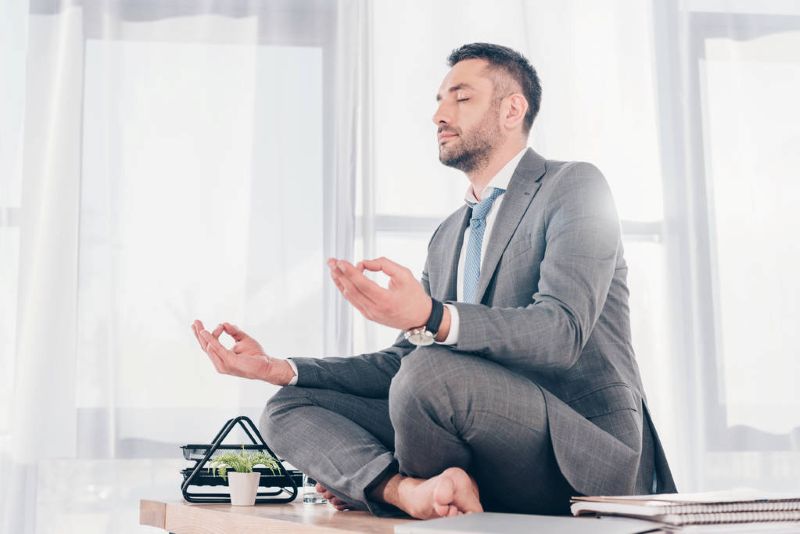
The mind is a powerful tool; it often cannot distinguish between a vividly imagined experience and a real one. Guided imagery, or visualization, leverages this principle to create a mental escape to a place of peace and tranquility. By focusing your imagination on a calming scene and engaging all your senses, you can trick your nervous system into responding as if you were actually there, reducing your heart rate, blood pressure, and stress hormones.
How to Practice:
- Close your eyes and take several slow, deep breaths.
- Begin to build a peaceful scene in your mind. This could be a warm beach, a quiet forest, a cozy fireplace, or any place—real or imagined—where you feel safe and completely at ease.
- Engage all your senses to make the scene as vivid as possible. What do you see? (The color of the water, the sunlight filtering through leaves.) What do you hear? (The sound of gentle waves, birds chirping.) What do you smell? (The salty air, damp earth.) What do you feel? (The warmth of the sun on your skin, the soft grass beneath you.)
- Spend 10-15 minutes exploring this peaceful place in your mind, allowing the feelings of calm and serenity to wash over you.
4. The 5-4-3-2-1 Grounding Technique
When anxiety and stress become overwhelming, it’s easy to get lost in a spiral of worried thoughts about the past or future. The 5-4-3-2-1 grounding technique is an excellent tool for pulling your mind out of this spiral and anchoring it firmly in the present moment. By methodically engaging your five senses to notice your immediate environment, you interrupt the anxious thought patterns and regain a sense of control.
How to Practice: This can be done anywhere, anytime you feel stress rising. Pause and gently notice:
- 5 things you can SEE: Look around and name five distinct objects. Notice details—the grain of wood on your desk, a crack in the pavement, the specific shade of a leaf.
- 4 things you can FEEL: Bring your attention to the physical sensations. Notice the texture of your clothing, the feeling of the chair supporting you, the temperature of the air on your skin, the weight of your feet on the floor.
- 3 things you can HEAR: Listen carefully and identify three sounds. It could be the distant hum of traffic, the ticking of a clock, or the sound of your own breathing.
- 2 things you can SMELL: Try to identify two distinct scents in the air. This might be the aroma of coffee, the faint smell of soap, or the fresh scent after a rain shower.
- 1 thing you can TASTE: Focus on one thing you can taste. You might notice the lingering taste of your last meal, or you can simply focus on the neutral taste inside your mouth.
5. Mindful Movement and Stretching
Often, our bodies hold onto stress in predictable ways—in the tight muscles of our neck, shoulders, and back. Mindful movement combines gentle physical activity with focused awareness, helping to release this physical tension while simultaneously calming the mind. Unlike a high-intensity workout, the goal here is not performance but presence. Activities like gentle yoga, tai chi, or simple, slow stretching can be incredibly effective.
How to Practice:
- Neck Rolls: Gently drop your chin to your chest and slowly roll your right ear toward your right shoulder. Hold for 15 seconds, then repeat on the left side.
- Shoulder Shrugs: Inhale deeply and lift your shoulders up toward your ears, holding them tightly. Hold for a few seconds, then exhale with a sigh and let them drop completely. Repeat 3-5 times.
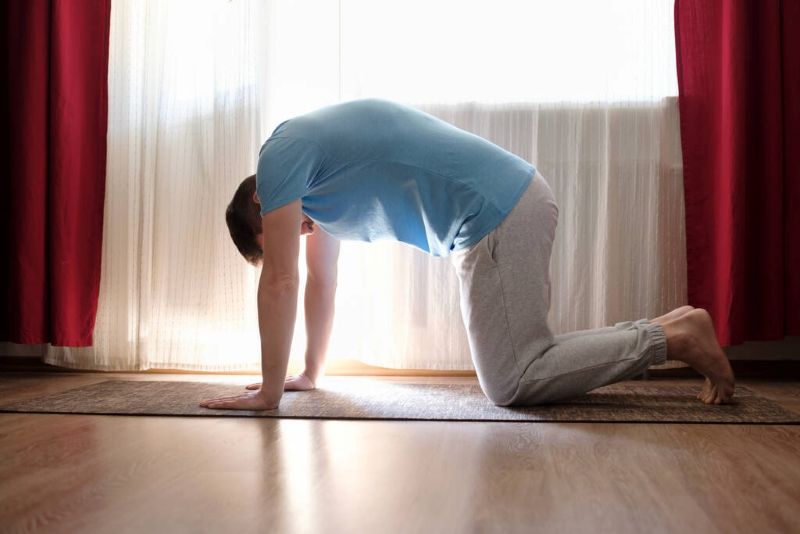
- Cat-Cow Stretch: If you are able, get on your hands and knees. As you inhale, drop your belly and look up (Cow Pose). As you exhale, round your spine and tuck your chin to your chest (Cat Pose). Coordinate your breath with the movement, focusing on the articulation of your spine.
6. The Practice of Gratitude
While it may not feel like a typical relaxation technique, a consistent gratitude practice is a powerful long-term strategy for rewiring the brain to combat stress. Our brains have a natural “negativity bias,” meaning we are more likely to focus on threats, worries, and problems. Gratitude actively counteracts this by training your attention on the positive aspects of your life. This shift in perspective can reduce depressive symptoms and foster resilience in the face of stressors.
How to Practice:
- Keep a gratitude journal by your bed.
- Each night before you sleep, write down three specific things that went well that day and for which you are grateful.
- Be specific. Instead of writing “my family,” write “the way my partner made me a cup of tea this morning” or “the funny story my child told me after school.”
- Reflect briefly on why that good thing happened. This helps you savor the positive feeling and integrate it more deeply.
By incorporating these techniques into your life, you can build a robust toolkit for managing stress. The key is consistency. Start by choosing one or two that resonate with you and practice them regularly, even on days when you feel calm. In doing so, you are not just fighting stress; you are actively cultivating a more peaceful and resilient state of being.
 Kim Monroe
  Hailey Reynolds