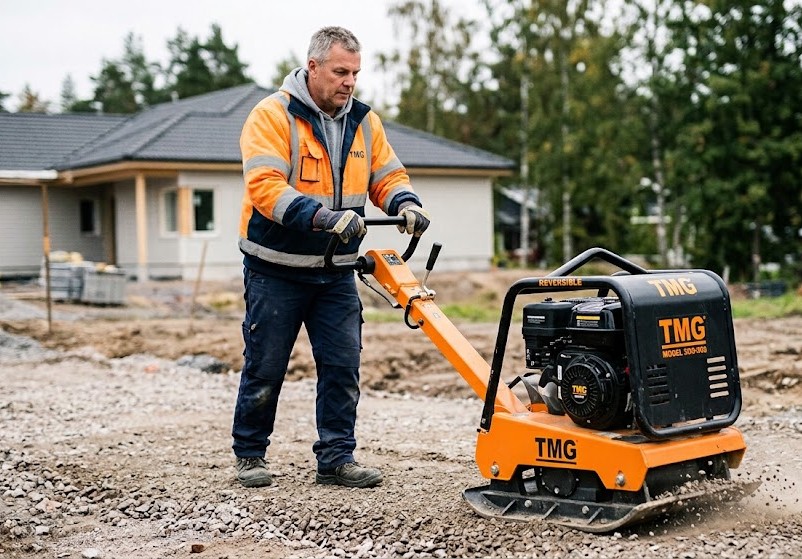
The Most Underused Setting on a Reversible Plate Compactor
6 min read
1035 words
Backfill and reinstatement work can get especially busy before the ground freezes. A reversible plate compactor is useful in trenches and other tight spaces because the operator can change direction without turning the machine around. But there is another setting that gets much less attention.
By adjusting the machine so the plate moves neither forward nor backward, the operator can keep it vibrating in one place. This stationary setting provides compaction where there simply isn’t enough room for the machine to travel, making it useful around structures, trench ends, corners and other difficult spots.
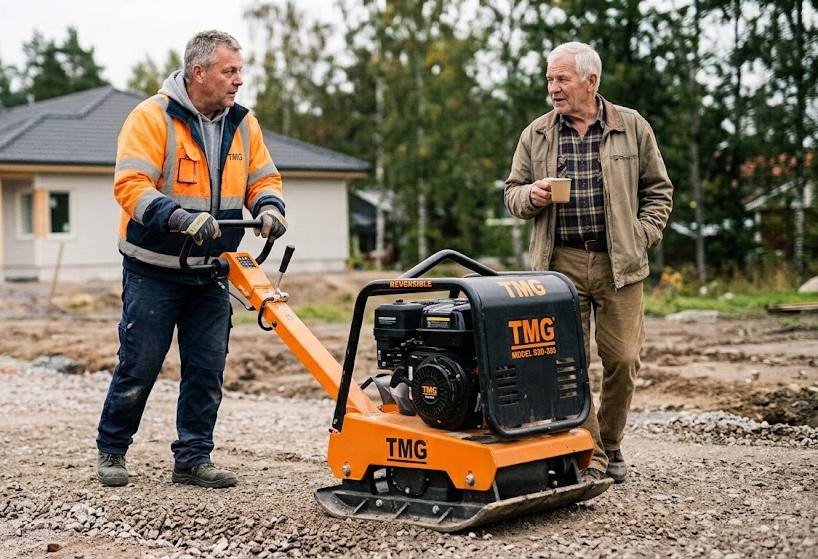
Reversible plate compactor spot compaction reaches places passes cannot
Some areas have no room for a normal pass. The end of a trench, a tight corner or the space directly beside a structure may need compaction without giving the machine enough room to travel.
Stationary operation solves that problem. Instead of moving forward or backward, the plate remains over the area being compacted while vibration works the material underneath it. The operator can then reposition the machine and repeat the process across the remaining area.
Manufacturers specifically describe stationary or spot compaction as an intended use for reversible plate compactors. Bobcat, for example, lists precise spot compaction among the benefits of its reversible models.
How to compact around a manhole is the clearest case
Backfill around a manhole or chamber creates a particularly awkward compaction area. The machine needs to work close to the structure without driving over it.
Stationary compaction allows the operator to place the plate over a section of backfill, compact that area, and then reposition the machine a short distance at a time. This makes it possible to work around the structure without treating the entire area as one continuous pass.
The same approach can be useful around utility structures, foundations, curbs and other obstacles where there is limited room for conventional travel.
It is important, however, not to assume that every settlement problem around a manhole is caused by poor compaction. Drainage, backfill material, installation methods and other factors can also contribute to settlement.
Phase angle is what makes stationary operation possible
The stationary setting comes from the way the exciter creates directional vibration. Reversible plate compactors use eccentric weights to generate the vibration that produces compaction. Changing their relative position changes the direction of the resulting force, allowing the machine to transition between forward travel, stationary vibration and reverse travel.
That means the operator isn’t simply putting the machine into a conventional neutral gear. The vibration system itself is being adjusted so the horizontal component of the force is reduced while the machine continues vibrating against the ground.
The result is a machine that can compact in place rather than automatically working its way across the surface.
An 8,500-lb reversible plate compactor delivers serious compaction force
The TMG-PC325 is listed with 8,500 lb of centrifugal force, a 13 HP Loncin G390F EPA engine and a 32-by-23-inch plate. TMG also lists a 3,750 VPM vibration frequency and a stated compaction depth of up to 34 inches.
Those numbers help explain why a machine in this class is intended for heavier compaction work rather than the occasional small landscaping job.
The important distinction is that 8,500 lb refers to centrifugal force, not the physical weight of the machine. TMG lists the shipping weight of the PC325 at 620 lb.
That is still a substantial machine to transport and maneuver, but confusing operating force with machine weight can give readers the wrong impression.
Loading and unloading still requires planning
A plate compactor weighing hundreds of pounds needs proper loading equipment and a suitable transport setup. The TMG-PC325 is listed with a 620-lb shipping weight, so it is not something an operator should treat like a lightweight walk-behind plate.
Use ramps and lifting equipment that are properly rated for the actual machine weight, secure the equipment for transport and keep people clear of the machine’s path during loading and unloading.
The manufacturer’s operating and safety instructions should always take priority over a general description of loading procedures.
The three working modes are easier to understand
A reversible plate compactor can be thought of in three basic operating states:
- Forward: The machine travels ahead while compacting.
- Reverse: The machine travels backward without requiring the operator to turn it around.
- Stationary: The machine vibrates in place for spot compaction.
The transition between these states is a fundamental part of how directional reversible compactors work. Operator manuals describe a continuous change between forward movement, standstill and reverse movement rather than treating them as completely separate functions.
Where a reversible machine pays off and where it does not
The biggest advantage is flexibility.
A reversible plate can work forward and backward in a trench without the operator having to find enough room to turn the machine around. Stationary operation adds another advantage by allowing compaction in areas where even a short pass isn’t practical.
That versatility comes with trade-offs. A reversible machine is generally heavier and more demanding to transport than a smaller forward-only plate. On a large, unobstructed area, a forward plate may be the simpler choice when there is no need for reverse or stationary operation.
The right machine therefore depends on the work. A contractor spending the day compacting open areas may value speed and simplicity. Someone working around trenches, utility structures and other obstacles may get considerably more value from directional and stationary control.
Reinstatement work is judged after the equipment leaves
The finished surface is what ultimately tells the story.
Poorly compacted backfill can settle after a project is completed, creating depressions and uneven surfaces that become visible long after the equipment has left the site. That makes the difficult areas around structures, edges and trench ends worth paying attention to during the original work.
Stationary compaction isn’t a replacement for proper lift thickness, suitable material, moisture control or the correct number of passes. It is another tool for dealing with locations where conventional machine travel is difficult or impossible.
That is what makes the stationary setting on a reversible plate compactor worth understanding. The machine isn’t only designed to go forward and backward. In the right situation, it can stay exactly where it is and put its compaction force to work.