From Short Term Gains to Sustainable Growth
6 min read
1188 words
When people talk about growth, they usually focus on speed. More customers, more revenue, more market share, more momentum. That all sounds exciting, and in the short run, it can be. But growth that depends only on constant acceleration often comes with a hidden cost. Teams get stretched, decisions get rushed, and small weaknesses become expensive problems later.
A more useful way to think about growth is to treat it like a system instead of a sprint. Real progress is not just about what you can gain this quarter. It is about whether your business, household, or organization can absorb pressure, adjust to change, and still move forward next year. That is why some of the smartest growth strategies begin with stabilization, not expansion. For people dealing with financial pressure, that might even start with debt relief as part of creating enough breathing room to make better long term decisions.
That shift matters because short term wins can be misleading. A big sales month can hide weak cash flow. A burst of customer demand can cover up operational bottlenecks. A lean budget can look efficient until one disruption throws everything off balance. Sustainable growth comes from building conditions that let good results repeat, even when the environment changes.
Why quick wins can quietly work against you
Short term gains are not bad. In fact, they can be incredibly valuable. They build confidence, create momentum, and prove that change is possible. The problem starts when quick wins become the whole strategy. If every decision is optimized for immediate payoff, you may end up borrowing strength from the future.
This happens all the time. A company cuts training to improve margins, then struggles with turnover and inconsistent service. A household delays dealing with debt to preserve flexibility, then loses more money to interest over time. A leadership team chases every trend that promises growth, then wonders why the business feels fragmented six months later.
The issue is not ambition. It is a lack of alignment between today’s actions and tomorrow’s goals. If a short term decision does not make the next good decision easier, it may not be helping as much as it seems.
The strongest growth often starts with reducing fragility
There is a common assumption that resilience is defensive, almost passive. In reality, resilience is one of the most practical growth tools available. It gives you room to recover, adapt, and keep operating when conditions are less than ideal.
The U.S. Small Business Administration emphasizes resilience planning as a way to help organizations stay operational before, during, and after disruption, including through stronger financial readiness and continuity planning. Business resilience guidance from the SBA reflects an important truth. Stable systems are easier to grow than fragile ones.
That same idea applies beyond business continuity. If your operations depend on one person, one client, one platform, or one perfect month, you do not really have growth. You have exposure. Sustainable progress usually begins by asking a simple question: what could interrupt this, and what can we strengthen now?
Sometimes the answer is financial. Sometimes it is operational. Sometimes it is cultural. In every case, the goal is the same. Create enough stability that growth does not collapse under normal stress.
Small improvements beat dramatic overhauls
People often imagine sustainable growth as a grand strategic plan. In practice, it usually looks much less dramatic. It is often the result of repeated, disciplined improvements that are easy to overlook because they are not flashy.
That may mean tightening invoicing timelines, clarifying team responsibilities, building a cash reserve, documenting repeatable processes, or reviewing which activities create profit and which only create busyness. None of these moves sounds exciting on its own. Together, they change the trajectory of an organization.
This is where many leaders get impatient. They want transformation to feel big. But durable progress often feels boring at first because it is built on consistency. Systems improve before headlines do. Margins improve before confidence does. Capacity improves before visible scale does.
If you want better long term outcomes, it helps to stop asking, “What will impress people now?” and start asking, “What will still be helping us a year from now?”
Innovation works better when it has a steady foundation
Innovation is often treated like the opposite of stability, but the two actually support each other. Teams are more creative when they are not constantly putting out fires. Leaders make better bets when they are not operating from panic. Growth becomes more intentional when it is driven by foresight instead of reaction.
NIST has published resources showing how risk management and continuous monitoring support stronger organizational decision making over time. The NIST Risk Management Framework overview highlights a broader principle that applies well beyond cybersecurity. Strong systems improve when they identify risk early, respond deliberately, and keep learning.
This is where sustainable growth becomes a mindset, not just a metric. You are not trying to predict every disruption. You are building an organization that can notice changes early, interpret them clearly, and adapt without losing direction.
That kind of adaptability is a competitive advantage. It also makes growth less exhausting. Instead of reinventing your response every time conditions shift, you rely on processes, priorities, and values that are already doing part of the work.
Long term vision should shape short term choices
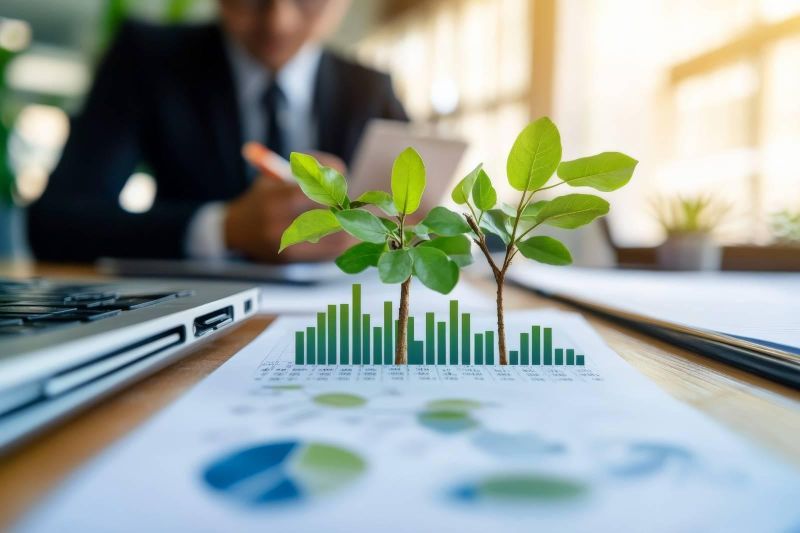
A vision is only useful if it changes what you do today. Otherwise, it is just branding. Sustainable growth happens when the long view is practical enough to guide immediate decisions.
For example, if your long term goal is a healthier company, then your short term choices should protect capacity, not just revenue. If your long term goal is financial independence, then your short term wins should reduce waste, improve consistency, and lower unnecessary risk. If your long term goal is a stronger organization, then your daily choices should support trust, clarity, and resilience.
This is why discipline matters more than intensity. Intensity can produce spikes. Discipline produces compounding results.
It also helps to redefine what a win looks like. A win is not only landing a new client or hitting a revenue target. It can also be shortening recovery time after a setback, improving retention, reducing debt pressure, or making key operations less dependent on guesswork. Those are the kinds of wins that make future growth easier and more affordable.
Growth that lasts is built, not chased
The most durable growth rarely comes from chasing momentum alone. It comes from designing for endurance. That means using quick wins wisely, but not worshipping them. It means respecting cash flow, process quality, team capacity, and risk awareness as much as top line progress. It means understanding that stability is not the enemy of expansion. In many cases, it is what makes expansion possible.
If there is a fresh way to think about growth, it is this: the goal is not just to get bigger. The goal is to become stronger while you grow. When immediate gains support resilience, innovation, and strategic clarity, growth stops being a series of temporary highs. It becomes something you can actually sustain.