What Is Milky Toner? Benefits & How to Use It
3 min read
554 words
What Is a Milky Toner?
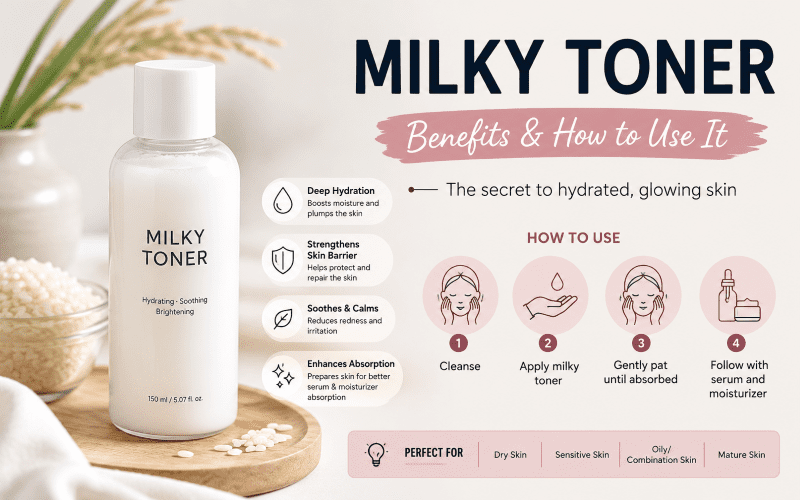
Unlike traditional toners that feel watery and lightweight, a milky toner has a soft, lotion-like consistency. It is typically an emulsion—a blend of water and nourishing lipids—that sits between a toner and an essence in your skincare routine.
Instead of focusing on stripping or “rebalancing” the skin after cleansing, milky toners are designed to hydrate, soothe, and strengthen the skin barrier.
Key Benefits of Milky Toner
Deep Hydration
Milky toners contain humectants like glycerin and hyaluronic acid that draw moisture into the skin, leaving it plump, soft, and hydrated.
Skin Barrier Support
Many formulas include ceramides and fatty acids that help reinforce the skin barrier, reducing moisture loss and improving resilience over time.
Soothes Sensitive Skin
Ingredients such as oat extract, centella asiatica, and rice water help calm redness, irritation, and inflammation, making milky toners ideal for sensitive skin types.
Improves Product Absorption
By lightly hydrating and softening the skin, milky toners create the perfect base for serums and moisturizers to absorb more effectively.
Who Should Use Milky Toner?
- Dry or dehydrated skin: Helps relieve tightness and restore moisture
- Sensitive or reactive skin: Provides gentle hydration without irritation
- Mature skin: Improves softness and reduces the look of dehydration lines
- Oily or combination skin: Lightweight hydration without heaviness or clogging
How to Use Milky Toner
Use milky toner after cleansing and before serums, both morning and night.
- Cleanse: Wash away dirt, oil, and impurities
- Apply: Pour a small amount into your palms and gently press into the skin (avoid cotton pads to reduce product waste)
- Absorb: Wait 20–30 seconds for full absorption
- Follow up: Apply serum and moisturizer to lock in hydration
Quick Comparison: Traditional Toner vs Milky Toner
| Feature | Traditional Toner | Milky Toner |
|---|---|---|
| Texture | Watery | Milky / Lotion-like |
| Main Purpose | Cleansing / pH balancing | Hydration / barrier support |
| Key Ingredients | Witch hazel, alcohol | Ceramides, hyaluronic acid, oat extract, squalane |
| Best For | Oily or acne-prone skin | All skin types, especially dry or sensitive skin |
Key Ingredients to Look For
- Ceramides: Strengthen and repair the skin barrier
- Panthenol (Vitamin B5): Soothes and supports healing
- Rice extract: Brightens and smooths skin texture
- Squalane: Lightweight oil that mimics natural skin moisture
- Hyaluronic acid: Boosts hydration and plumps the skin
Common Mistakes to Avoid
- Skipping moisturizer: Milky toner hydrates but does not seal moisture in
- Using too much product: A few drops are enough for full coverage
- Incorrect layering: Apply before serums and actives for best results
Frequently Asked Questions
Is milky toner good for acne-prone skin?
Yes. Many milky toners are non-comedogenic and contain calming ingredients like centella asiatica and panthenol that help reduce inflammation without clogging pores.
Can I use milky toner in the morning?
Absolutely. It creates a smooth, hydrated base that works well under sunscreen and makeup.
Is milky toner the same as an essence?
They are very similar. Both focus on hydration and skin preparation, and in modern skincare routines the terms are often used interchangeably.