Top Internet Connectivity Issues and How to Fix Them
7 min read
1310 words
Modern life requires a good internet connection to work, study, socialize, and enjoy other types of entertainment. However, the sad truth is that many internet users spend hours complaining about their frustrating connections. Slow or unpredictable internet speeds can ruin a productive day, whether you’re sending an email, streaming your favorite show, or attending an online class. Common problems to internet connectivity their simple solutions research is done with some of the most common connectivity problems of the internet and their very simple solutions.
Common Connectivity Problems of the Internet with How to Correct Them
Poor Wi-Fi Connection is the topmost connectivity issue. A weak signal can slow down your internet and, in some cases, prevent it from connecting entirely. The distance that exists between the device and the router and some wall and furniture obstructions weaken the signal.
If staying in the UK, your esim for uk may depend on its network signal strength. Indeed, to date, statistics up to 2024 have already noted over 10 million users within, for whom the eSIM technology generates mobile network connectivity completely independently of any user’s physical SIM card. That is why, if the internet connection drop continues happening, it might either be the network or Wi-Fi.
In that case, moving closer to the router can do the trick, or installing a Wi-Fi extender to strengthen the signal. Sometimes, it is advisable to reset the router to flush out temporary problems and get the connectivity back in good shape.
Slow Internet Speeds and How to Improve Them
Another factor is that people who use Wi-Fi have their internet slow down. This problem may be experienced despite a strong Wi-Fi signal. Several other causes that might affect internet speed include huge traffic in internet use, obsoleted appliances, and networks becoming congested.
Slow speeds might occur on several users mostly due to people operating on one network during busy hours. Upgrade to a high-speed internet plan and consider using a modern router that supports faster connectivity for a smoother experience.
Scanning for devices is taking too much bandwidth, like streaming services or large downloads, which will help you shift your connection towards the faster side as well. If you have an eSIM in the UK, then ensure that your plan allows a high-speed data package that will not make your shift even compulsory for unnecessary slowdown. You can also try changing to another Wi-Fi channel on your router to minimize interference from other networks.
Intermittent Connectivity Problems and Solutions
Another annoying issue, with your internet, may be intermittent connectivity. This problem arises when you feel your internet is connecting and reconnecting for some reason you’re not doing anything to make it happen. Sometimes, poor network connection results from faulty equipment or improper placing of routers and many other reasons.
If you are using an eSIM in the UK, then this problem can be attributed to bad network coverage or some problem with your mobile network. The problem of intermittent connectivity can be solved by first looking for loose cables connected to your router. You can reset your router or modem if you have these kinds of problems.
You can also consider moving your router to a better location in your house so that it covers your entire house. In some cases, the problem does not lie in the device. Connectivity issues on laptops, smartphones, and tablets can stem from outdated software or excessive background applications.
If you find that one gadget is slow, or it keeps losing its connection time and again, you should restart it. You can upgrade the software on such a gadget too. If your device has eSIM in it, ensure you are using one that is supported by the particular network you are trying to connect to, especially if in the UK.
Sometimes, even a gadget will have a not-very-good Wi-Fi adapter or even a network card. Another point is to see that your gadget is not miles away from your router because that distance can easily make the signal weak.
Network Congestion and How to Manage It
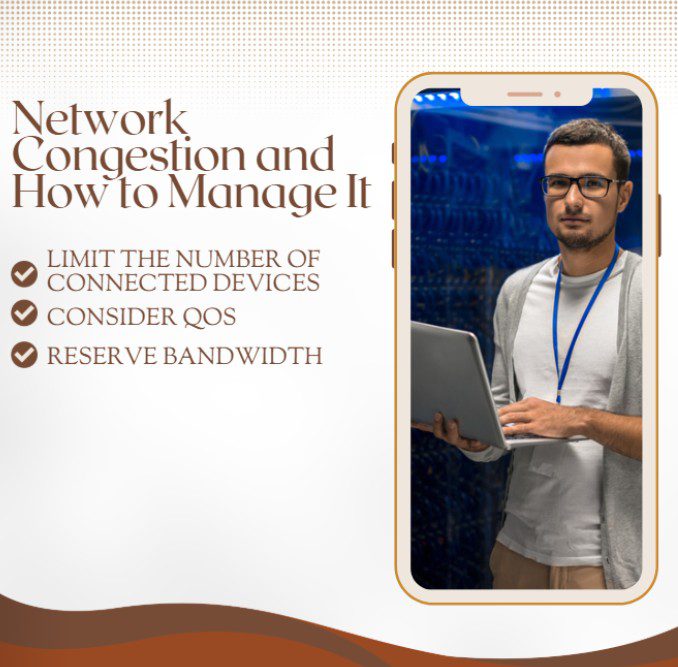
Network congestion is another thing that most people fail to notice. This is mainly because most devices use too much data at a go in a single network. For example, when many users in your home are streaming videos, playing online games, or working from home, this slows the whole network.
One problem you may face with the use of mobile internet is the occurrence of slow internet at times. This slowdown occurs when multiple devices simultaneously use the same bandwidth for extended periods.
So, limit the number of connected devices to a certain extent for simultaneous use. Also, consider QoS on your router so you can reserve bandwidth for those devices or specific tasks like video calls or working online.
Mobile Network Problems and Solutions
If you are experiencing trouble accessing the internet on your mobile, then it could be a problem with your mobile network. Mobile network strength varies from region to region in the UK. At times this may prevent a person from holding a stable connection to the internet.
Where signal strength is weak as the case is when you are in a rural area or there are a lot of buildings, at that point, one may only experience slow access or even lose the internet altogether.
This issue is more likely if you’re using an eSIM, given the nature of mobile connections. First, check your network settings to ensure that your device is connected to the strongest available signal. You can opt for another network or increase your data plan for better coverage.
How to Contact Your ISP for Help
Sometimes, the problem may be with the internet service provider. If your connectivity is going bad very frequently, then probably it is time to check if the ISP is having an outage in your area or not. Generally, you can check this from the ISP website or by contacting their customer care. If it is an outage, then you just have to wait for the services to get back.
But if it is a frequent problem and probably nothing is down within the network, then most probably this is the time to call your ISP to check up on your line. They probably will repair it remotely or visit your place to check on your connection.
How to Test Your Internet Speed
The speed of the internet may help troubleshoot your internet connectivity. The speeds will help determine if you’re receiving the speeds your ISP promised you, or maybe you have a connection problem. All applications and almost all websites give free speed tests; among the popular ones is Ookla’s Speedtest which calculates download as well as upload speeds along with ping.
If your speeds are significantly lower than expected, the issue could be network congestion or an inefficient router. You can monitor the improvements once the problem has been corrected by running regular tests for internet speed.
Conclusion
In simple words, Internet connectivity problems are very common but most of them have very easy solutions. Whatever the case- weak Wi-Fi, slow speeds, or connectivity issues in and out, these steps will surely guide you toward a much-improved connection.
With understanding the problem areas now and knowing of them, troubleshooting will surely guarantee you an uninterrupted and efficient Internet connection.
FAQs
- If the router is not working, what do I do about my internet connection?
You can restart your router and check all your cables for proper connections on the modem.
- My internet speed is slow while my signal strength is strong, what do I do?
Disconnect devices that consume too much bandwidth and consider upgrading your router.
- Can I use my eSIM if I am in a different country?
Yes, you can use mobile data in many countries with an eSIM, but do check for international coverage.