
5 min read
951 words
Ever feel like a wave of anxiety washes over you, leaving you feeling stressed and overwhelmed? You’re not alone. In our fast-paced world, finding simple, effective tools to manage our emotional well-being is more important than ever. Enter EFT Tapping —a gentle yet powerful technique that’s gaining popularity for its incredible ability to reduce stress and calm the mind. If you’ve been curious about this “tapping” thing, you’ve come to the right place. This guide will walk you through what EFT Tapping is, the specific tapping points for anxiety, and the meaning behind each one. Let’s get started on your journey to greater peace.
So, What Exactly Is EFT Tapping?
EFT stands for Emotional Freedom Technique. At its core, EFT is a mind-body method that combines elements of modern psychology with ancient Chinese acupressure.
Think of it as an emotional reset button. By gently tapping on specific meridian points on your body (the same ones used in acupuncture) while focusing on a negative emotion or physical sensation, you can send calming signals to your brain. This process helps to rewire your brain’s response to stress, essentially “turning down the volume” on anxiety, fear, or past trauma.
The beauty of EFT tapping is its simplicity. It’s free, you can do it anywhere, and it puts you in control of your own emotional state.
The 9 EFT Tapping Points: Your Roadmap to Calm
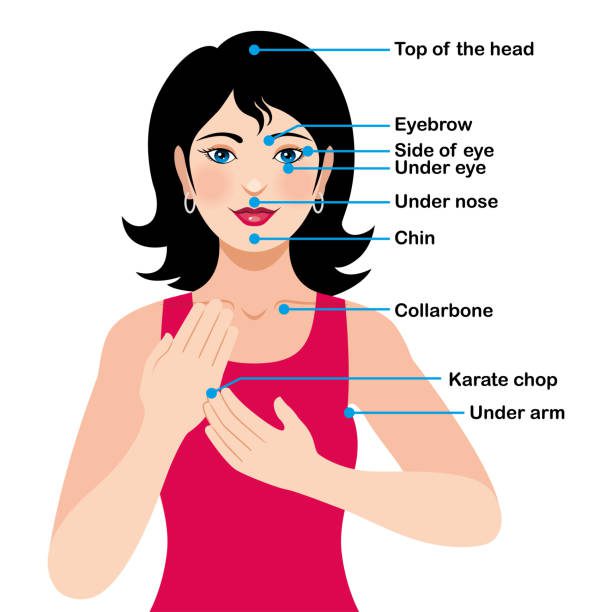
The foundation of EFT lies in stimulating these key energy centers. While the sequence is important, don’t worry about being perfect. The intention behind your tapping is what truly counts.
Here are the nine main EFT tapping points, where to find them, and their commonly associated emotional meanings.
1. The Karate Chop (KC) Point
- Where to find it: On the fleshy outer part of your hand, between the base of your pinky finger and your wrist. It’s the spot you’d use to do a “karate chop.”
- Meaning: This point is used for the “setup” statement. It helps to psychologically prepare you for the shift and corrects “psychological reversal”—a state where you unconsciously resist positive change.
2. The Eyebrow (EB) Point
- Where to find it: On the inner edge of your eyebrow, right where the hair begins to grow, just above the bridge of your nose.
- Meaning: This point is often linked to trauma, grief, and shock. Tapping here can help release deep-seated emotional pain and fear.
3. The Side of the Eye (SE) Point
- Where to find it: On the bone on the outer corner of your eye.
- Meaning: Connected to shock and resistance, this point helps address feelings of being stuck or unwilling to see things from a new perspective.
4. Under the Eye (UE) Point
- Where to find it: On the bone directly under your eye, aligned with your pupil.
- Meaning: This point is a powerhouse for addressing fear, anxiety, and panic. It’s closely tied to our primal “fight or flight” response.
5. Under the Nose (UN) Point
- Where to find it: In the groove between your nose and your upper lip.
- Meaning: Often associated with feelings of shame, embarrassment, and powerlessness. Tapping here can help restore a sense of control and self-worth.
6. The Chin (CH) Point
- Where to find it: In the crease between your lower lip and the point of your chin.
- Meaning: This point can help you let go of confusion, uncertainty, and feeling “stuck.” It’s about finding clarity and moving forward.
7. The Collarbone (CB) Point
- Where to find it: Find the U-shaped notch at the base of your throat. From there, go down about an inch and then outward an inch toward your shoulder. Tap in that hollow spot.
- Meaning: This is a major energy center that helps process and release complex emotions. It’s excellent for general anxiety and feelings of being overwhelmed.
8. Under the Arm (UA) Point
- Where to find it: About four inches down from your armpit, along the side of your body. For women, this spot is often where the bra strap sits.
- Meaning: This point is connected to feelings of guilt, worry, and self-judgment. Tapping here fosters self-acceptance and helps release negative self-talk.
9. The Top of the Head (TH) Point
- Where to find it: On the crown of your head, in the center. It’s a tender spot that you can tap with both hands.
- Meaning: This point helps to integrate all the other points and bring a sense of wholeness and spiritual connection. It’s great for wrapping up a tapping session and sealing in a sense of peace.
How to Use Tapping for Anxiety: A Simple Sequence
Now that you know the points, here’s how to put them into practice for anxiety.
- Identify the Feeling: Bring to mind the specific situation or feeling of anxiety. Rate its intensity on a scale of 0 to 10 (0 being no anxiety, 10 being the worst).
- The Setup: Tap the Karate Chop point continuously while saying a setup phrase three times. For example: “Even though I feel this knot of anxiety in my stomach, I deeply and completely accept myself.”
- The Tapping Sequence: Move through each of the remaining eight points (Eyebrow through Top of the Head), tapping about 5-7 times on each. As you tap each point, simply state a reminder phrase, like “this anxiety” or “this tight feeling in my chest.”
- Re-rate: After completing the sequence, take a deep breath and rate the intensity of your anxiety again. You’ll likely notice it has decreased. If it’s still above a 2 or 3, repeat the process until you feel a sense of calm.
Your journey to emotional freedom begins with a single tap. This simple technique is a profound gift you can give yourself whenever you need it.
 Lynn Leblanc