
6 min read
1065 words
It’s often said that truth is stranger than fiction, and sometimes, it’s also more bewildering than a snowstorm in July. Few headlines in recent memory have encapsulated this sentiment quite as perfectly as the news that the Trump administration, in its sweeping revisitation of global trade, reportedly targeted the remote, icy continent of Antarctica with tariffs. Imagine the scene: a customs agent, perhaps bundled in layers of thermal gear, skiing across vast, pristine glaciers, clipboard in hand, to demand import duties on a shipment of scientific equipment for a research station. The sheer absurdity of it all is enough to make anyone do a double-take, or perhaps, as some might confess, choke on their morning coffee. But beyond the initial chuckle, this curious policy decision raises profound questions about global trade, international cooperation, and the value we place on scientific endeavor in the face of geopolitical maneuvering. Let’s delve into the peculiar case of tariffs on Antarctica.
A Continent of Science, Not Commerce: What Are We Really Taxing?
When one thinks of international trade, images of bustling ports, towering cargo ships, and vibrant commercial hubs typically come to mind. Antarctica, however, is none of these things. It is, by international treaty, a continent dedicated solely to peace and scientific research. It hosts no native human population, no sprawling cities, and certainly no significant commercial industry in the traditional sense.
Its “outposts” are, in fact, vital research stations operated by various nations. Here, brave scientists, often battling extreme conditions, are engaged in critical work:
- Climate Change Research: Monitoring melting ice sheets, studying sea-level rise, and analyzing atmospheric data crucial for understanding global warming trends.
- Glaciology: Uncovering Earth’s climatic history through ice core samples.
- Oceanography: Exploring the unique marine ecosystems and their resilience to environmental changes.
- Wildlife Biology: Studying the migratory patterns and health of iconic species like penguins, seals, and whales, often indicators of broader ecological well-being.
The “goods” typically shipped to Antarctica are not luxury imports or high-volume exports. They are essentials: food supplies, fuel, life-sustaining equipment, and specialized scientific instruments. These items are the backbone of human survival and research in one of the planet’s most inhospitable environments. To levy tariffs on such necessities is to impose a direct tax on the pursuit of knowledge itself.
The Logistical Labyrinth: Penguins, Payments, and Peculiarities
The practical implications of imposing tariffs on Antarctica quickly descend into a realm bordering on the surreal. The fundamental questions arise:
- Who pays? Are the nations operating research stations expected to absorb these costs, adding a new financial burden to already expensive scientific endeavors?
- What are the taxable “commodities”? Is it the specialized sonar equipment, the freeze-dried rations, or perhaps even the snowmobiles vital for transportation?
- How are tariffs collected? Is a customs office to be established at the South Pole? The scenario paints a picture of absurdity, imagining a bureaucratic nightmare unfolding amidst blizzards and ice floes.
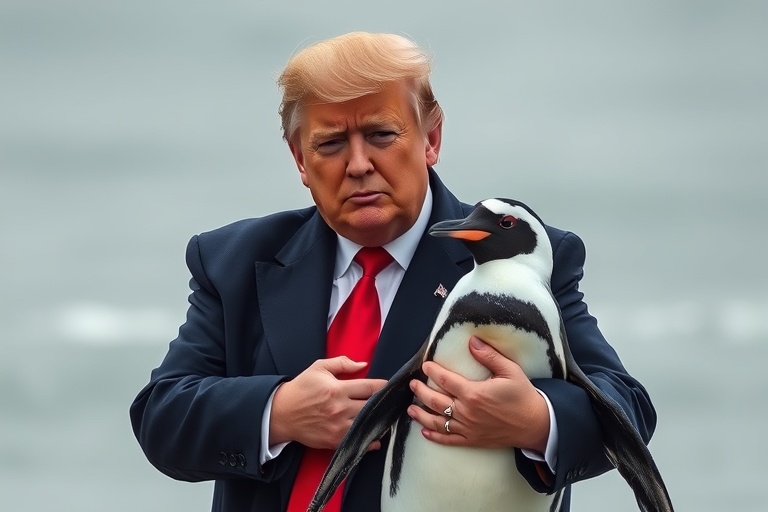
The humor, while dark, is unavoidable. One might amusingly ponder if Emperor penguins, with their distinguished waddle, would be classified as importers or exporters. Would payment be accepted in freshly caught krill, or perhaps through some ingenious “PenguCoin” cryptocurrency backed by their undeniable adorableness? The reality, of course, is far less whimsical, representing a genuine, if baffling, impediment to vital work. Seals, too, might find themselves caught in this bizarre economic web, their fish-consumption habits potentially subject to arbitrary trade regulations.
A Bitter Chill: Climate Change, Tariffs, and a Troubling Paradox
The most profound irony of these tariffs lies in their potential impact on climate change research. During the Trump administration, there was a well-documented skepticism, and at times outright dismissal, of scientific consensus on climate change. To then impose financial barriers on the very institutions dedicated to monitoring and understanding this global phenomenon in one of its most critical regions is a staggering paradox.
It’s akin to dimming the lights in a room specifically designated for studying darkness. The research stations in Antarctica are global sentinels, providing invaluable data that informs international policy, disaster preparedness, and environmental conservation efforts worldwide. By increasing the costs and logistical hurdles for these stations, tariffs could inadvertently hinder critical data collection, slow down research projects, and ultimately impede our collective ability to respond to a looming global crisis.
This policy decision, if truly implemented and maintained, sends a troubling message: that even the pursuit of universal scientific truth, especially concerning sensitive environmental topics, can become a casualty in the broader geopolitical game of trade wars. It undermines the spirit of international cooperation that has, for decades, allowed Antarctica to remain a beacon of peace and scientific collaboration.
Beyond the Ice: Ramifications for Global Policy and Scientific Diplomacy
While the notion of “tariffs on Antarctica” might seem like a quirky footnote in economic history, its implications extend far beyond a few research stations. It challenges the very foundation of scientific diplomacy and the shared commitment to understanding our planet.
The Antarctic Treaty System, established in 1959, is a remarkable testament to international cooperation, setting aside an entire continent for peaceful purposes and scientific investigation. Policies that complicate or penalize this shared pursuit risks eroding that fragile framework. In an era where global challenges like climate change, pandemics, and environmental degradation demand unprecedented international collaboration, such barriers are counterproductive.
The world needs more, not less, scientific research from Antarctica. It needs seamless cooperation, unburdened by arbitrary economic sanctions that treat life-sustaining supplies and research equipment as commercial goods to be taxed.
A Call for Sanity in the Icy Wilderness
Ultimately, the hope remains that such policies, born perhaps from overzealous bureaucratic blanket statements or a lack of granular understanding, are quietly rescinded or simply ignored in practice. The last thing the world needs is a trade war with a continent largely populated by penguins and seals. They are already contending with profound threats like melting ice caps and ocean acidification—concerns that the very scientists targeted by these tariffs are working tirelessly to understand and mitigate.
The case of tariffs on Antarctica stands as a stark reminder of how disconnected policy can sometimes become from practical realities and broader global imperatives. It underscores the importance of clear thinking, respect for scientific endeavor, and a recognition of the unique, shared value of places like Antarctica. Because if we lose the battle for sanity in trade policy with penguins, what hope do we have for more complex international challenges?
Looks like no corner of the globe is off-limits.